Defence of the Village
Translation details
Model:mistral-medium-2604.Translated text
Section titled “Translated text”Game marked with an asterisk in the book: more suitable for older scouts.
The Whites must capture the village, which is defended by the Reds. The village is considered captured if at least one of its entrances is taken. For this purpose, either a locality with multiple roads and paths leading to it is chosen, or a terrain the size of a village is selected, with flags placed around its perimeter to mark the village’s entrances.
The defenders, the Reds, are weaker than the attacking Whites, but their forces are not less than two-thirds of the enemy’s strength.
What does capturing a village entrance entail? If the Whites manage to gather, 10 paces in front of any flag (entrance), a detachment of their own in a number exceeding the Reds stationed at that flag, the entrance is captured. If, however, the Reds manage to reach the entrance in a number at least equal to the Whites attacking that point, the assault is repelled.
Based on this fundamental rule, the course of the exercise can be imagined. The Reds, not knowing from which direction the Whites will approach, first seek to gather information about them. They can do this in various ways. The simplest is to send small reconnaissance patrols in all directions (small, so as not to weaken their own forces too much)—especially in areas with poor visibility—and to post guards (possibly with signal devices) on elevated points. Their duty is to spot the enemy and quickly report to the command, which is located with the main forces in the center of the village. However, delivering information may take a long time. In such a case, it would be advisable to set up a relay post system in several lines radiating from the village; the frontmost post receives a written report (how many Whites? — where — when), which then quickly travels along the post line to the main headquarters. Since such a post system would again divert a group of people, instead of patrols, only two brave scouts can be sent ahead of the post: one to deliver the information, and the other, while retreating before the approaching enemy, to maintain continuous contact with them. If the enemy approaches,
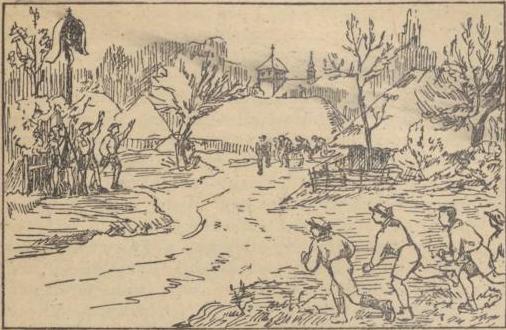
Fig. 57.
the post line is naturally shortened (other inactive lines are withdrawn), and every scout freed from duty quickly proceeds to the assembly point in the center of the village.
The Reds are thus prepared for the attack and strongly man the threatened entrance, but they keep part of their forces in reserve so that, in case of a surprise, they can send reinforcements to the endangered point. However, there must still be guards at the entrances that are currently safe, as one must always account for the possibility of a surprise attack.
Meanwhile, the Whites approach the village as covertly as possible. They may advance in a single detachment or divide into smaller groups. Reconnaissance patrols try to determine the Reds’ positions and the weakest points of their defense. Considering the terrain conditions, the distribution of the Reds’ forces, the distance between one entrance and another, etc., the Whites decide on the point of attack. To keep the enemy uncertain until the last moment and not reveal their intentions, they drive off the enemy scouts, make feigned movements, hide part of their forces from the enemy’s view, and even launch deceptive attacks to divert the enemy from the actual point of assault. The most important thing is that the Reds do not know how many Whites are gathered at a given point or where the rest, if hidden, are located. A small group emerging at the last moment can sometimes tip the scales, especially if attacks can also be carried out at other points, and the Reds do not know which is a feint to deceive the enemy and which is the real one. The Reds may also, to clarify the situation and hinder the Whites’ actions, launch a larger detachment to attack the approaching Whites and thus force them to retreat.
As can be seen, the situation can change constantly, and only the side with good organization can win—that is, one that always has information about what is happening and the ability to quickly deploy a detachment where needed. Therefore, the Reds must, on the one hand, have good scouts who constantly follow the Whites and continuously report on their movements; on the other hand, from each village entrance to its center, they must have a relay post system so that both the news of an approaching attack and the sent reinforcements arrive on time.
The Whites, in turn, must (in addition to a well-organized reconnaissance service so that every important piece of information quickly reaches the main headquarters) conceal part of their forces and maintain uninterrupted communication between detachments, either through messengers or with flag signals, so that if the original plan is disrupted, they can carry out a new one smoothly and with full energy.
If, within the specified time, one entrance to the village is forced, the Whites win; if not, the Reds win.
Individual enemies can be taken prisoner (by removing the armband), but they must not be released. If two detachments of roughly equal strength (i.e., with a difference of no more than 3 people on either side) meet on the exercise terrain, each must retreat 300 paces; if the advantage is greater, the weaker detachment retreats. A detachment is considered to be a group of at least 5 people. (With a large number of participants, this ratio can be changed, e.g., a detachment is considered weaker if its strength is in a 2:3 ratio to the other detachment, and detachments are considered equal if the ratio is smaller). Naturally, this rule does not apply to encounters at the village entrance, where even a small advantage constitutes victory.
Both sides must have judges with clearly visible badges from a distance, who resolve any misunderstandings that may arise.
This exercise can involve a very large number of scouts. However, the size of the “village” should always be adapted to the number of participants. Furthermore, since there may be too many exits, some of which are not visible, all entrances that may be attacked must be marked with flags.
The Reds can be assisted in the first part of the task by indicating the starting point of the Whites. However, the Whites may freely change their marching direction. The exercise begins at a distance of several kilometers at a specified time.
Source of scan: Polona / National Library of Poland, marked “Public domain”. View scan — PDF pages 239–243.
Metadata
Section titled “Metadata”- Type: game
- Traits: Not stated in the source
- Source: Zygmunt Wyrobek, Harcerz w polu: zabawy i gry terenowe (1946)
- Printed pages: 233–237 / PDF 239–243
- Digital edition: Digital edition · Source record
- Open the edition at the relevant page: p. 233
- Read the source text: hwp-115