In Constant Contact with the Enemy
Translation details
Model:mistral-medium-2604.Translated text
Section titled “Translated text”Game marked with an asterisk in the book: more suitable for older scouts.
This exercise is intended to demonstrate proficiency in maintaining contact with a once-located enemy and in transmitting information about them under changing tracking conditions.
One or two white patrols receive an order to set up camp and surround it with guards at a location several (4–7) kilometers away from the red headquarters. The order specifies the exact time to remain in camp
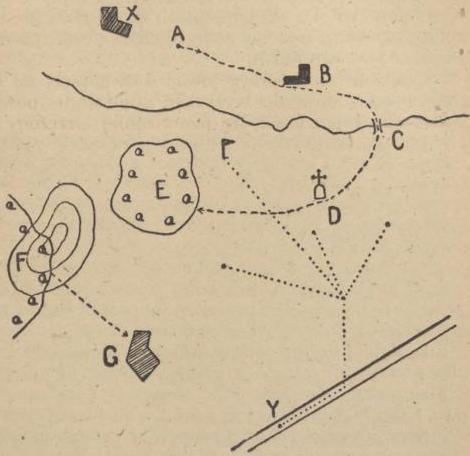
Fig. 56.
in camp, the hour to break camp, the route the unit should take afterward, the points where it should stop, and what to do at each location.
For example, at point A (according to the map), the unit must set up camp, deploy 4 outposts, light campfires, and remain until 4:00 PM; at that time, they must break camp, march in a secured formation through locality B to point C, and reconnoiter the bridge over the river. At 5:00 PM, they must move on through D to point E, remain hidden there, and send out scouts to determine if there are any enemies nearby. If enemies are detected, the unit must try to disappear from their sight (without scattering) in such a way that, by circling, they reach point F unnoticed, no later than 6:00 PM. If they arrive there undetected, they must remain hidden until 6:30 PM, then proceed to point G, where they will halt until 7:30 PM, at which time the exercise ends. If, however, they are discovered at point F, they must scatter, and each scout individually must reach point G stealthily and remain hidden there until the end of the exercise, i.e., until 7:30 PM.
The white unit receives such a written order. The leader who issued it can verify whether the information brought by the reds corresponds to the actual state of affairs, whether it is precise and accurate, or whether it reveals deficiencies. Apart from the moment of breaking contact with the enemy, the subsequent unnoticed passage, and possibly scattering and regrouping in hiding at the final point, the whites behave rather passively. The active and proper role in the exercise falls to the reds.
The reds receive a more laconic order. In this case, it would read as follows: “At a distance of 5 km in the direction of Z, near the village of X, there is a white unit. Locate its position, maintain constant contact with it, and regularly report all its actions to the headquarters at point Y. Organize the transmission of information in stages, in various forms.”
What, then, do the reds do? First, they send reconnaissance patrols to locate the enemy (there are 2–3 times as many reds as whites, as many people must serve as messengers). These patrols are given several (1–2–3) points to which they must send reports. From these points backward, toward the main headquarters, relay posts are set up, converging at one location. Here is a station that collects incoming messages by post and forwards them along a single line to the road. On the road, there is a cyclist station, which again transports dispatches in stages to the main headquarters. (Fig. 56).
In addition to foot messengers, signal stations can also be organized. One or two are located at the front, and the receiving station is together with the post-collecting station.
When the whites move from their location, the postal lines are also shortened, either by withdrawing the forward posts or by reducing the distances between individual posts. In any case, the reconnaissance patrols must always know where to send the information they have gathered, i.e., know the relay line and, if necessary, the sign by which the start of the post can be found. Similarly, the signal stations gradually retreat.
Thus, some of the reds serve as messengers, while others are tasked with closely monitoring the whites’ actions, never losing sight of them throughout the entire time (which may not be easy given the whites’ previously assigned task), and immediately transmitting every observation to the main headquarters.
The entire exercise is not difficult and will show whether the scouts can organize a communication service and whether it will function smoothly. Given the strict definition of the whites’ actions, no mistake will go unnoticed; it will always be known when and where an error occurred. A discussion of the exercise, citing dispatches and simultaneously emphasizing what the whites were doing at any given time, will be a very good lesson.
The leader should very precisely define the route, type, and timing of the whites’ actions, and the whites must execute all orders as strictly as possible. To save time and distance, the exercise can begin halfway between the whites’ camp and the reds’ headquarters: patrols go forward, and the postal line is set up behind.
Neutral observers are needed to ensure that the timing of each action is strictly followed.
Scan source: Polona / National Library of Poland, marked “Public domain”. View scan — PDF pages 230–234.
Metadata
Section titled “Metadata”- Type: game
- Traits: Not stated in the source
- Source: Zygmunt Wyrobek, Harcerz w polu: zabawy i gry terenowe (1946)
- Printed pages: 224–228 / PDF 230–234
- Digital edition: Digital edition · Source record
- Open the edition at the relevant page: p. 224
- Read the source text: hwp-112