Difficult Reconnaissance
Translation details
Model:mistral-medium-2604.Translated text
Section titled “Translated text”Game marked with an asterisk in the book: more suitable for older scouts.
White patrols guard the railway line against destruction by the reds and report their observations via relay post — the reds must uncover the white’s protective arrangements.
A designated section of a road running through a forest represents the railway line. Along it, from the center toward the ends of the section, two white patrols (each of 4–5 people) walk. This forms one line of guards. Two other patrols guard in the same manner along the edge of the forest, approximately 1 km away from the railway line, thus forming a second line of guards. In the forest between these two lines, two flags are planted, and two people are stationed at each — these are the positions of the units that sent patrols to the forest’s edge. Beyond the railway line is station S, which collects all reports, and from there, a relay post leads further back to the main headquarters.
The forward patrols must send written reports to the flags, from which they are then forwarded to the collection station; the patrols guarding along the railway send them directly to the station.
The reds, with a strength of one squad (8–12 people), are only told that the railway line is guarded by the whites and that the flags mark the positions of the units. They do not know whether there is one
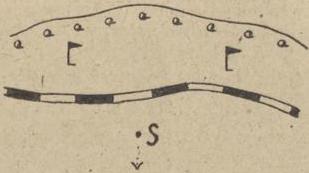
Fig. 53.
or more lines of guards, nor how the white line is guarded. They are ordered to sneak up to this line, uncover the positions of the units and the method of guarding. A point is also designated for them to send their reports, and a relay post can also be arranged to their headquarters.
If it is difficult to find a road through a forest with an edge at the appropriate distance for this exercise, a road through another type of terrain can be chosen, provided it is not easily visible and facilitates stealthy approach. The length of the railway line must be precisely marked, as well as the forest’s edge along which the patrols are to move.
The reds, whether in groups of two or three or individually, try to sneak into the forest and reach the line to determine how it is guarded and where reports are sent. Some will realize that they must first penetrate the first line of patrols; others will later spot the flags and confirm that they are the first stations collecting reports. However, this information must then be carried back out of the forest, meaning they must sneak through again. All of this is a very difficult task, requiring great patience and skill, the exploitation of all terrain conditions, and above all, great presence of mind. The whites must not be attacked or taken prisoner.
The whites have an easier task. They only monitor the movements of the reds and drive them away from the line, and they may take individual enemies prisoner. However, they do this only when the opportunity arises, as their primary task is to guard the line and not leave the designated path.
A prisoner is taken by calling out to them from a distance of 10–15 paces. If the distance is greater, the called-out person must retreat a few hundred paces until they are out of sight. This makes it difficult for the opponent to observe one’s own actions. The white patrols are not required to constantly walk back and forth; they may stop for a moment at a certain point, but they must not split up to cover the entire line.
If a red scout penetrates the first line and this is noticed, the patrols must be even more vigilant about their return, so that if it is not possible to take them prisoner or turn them back, at least their return can be delayed. The reds win if, within the designated time, they provide an accurate description of how the whites guard the line and the locations of their units. Otherwise, the whites win.
Scan source: Polona / National Library of Poland, marked “Public domain”. View scan — PDF pages 214–216.
Metadata
Section titled “Metadata”- Type: game
- Traits: Not stated in the source
- Source: Zygmunt Wyrobek, Harcerz w polu: zabawy i gry terenowe (1946)
- Printed pages: 208–210 / PDF 214–216
- Digital edition: Digital edition · Source record
- Open the edition at the relevant page: p. 208
- Read the source text: hwp-106