Between the Hammer and the Anvil
Translation details
Model:mistral-medium-2604.Translated text
Section titled “Translated text”Game marked with an asterisk in the book: more suitable for older scouts.
One patrol of Whites plays against three patrols of Reds. The Whites receive the order: «Reconnoitre the road section M—N—O—P and wait in P until hour X for their own unit (i.e., a scout with a flag), which will travel along this road. If they encounter the enemy, report this to M and ascertain where the enemy is and what they are doing».
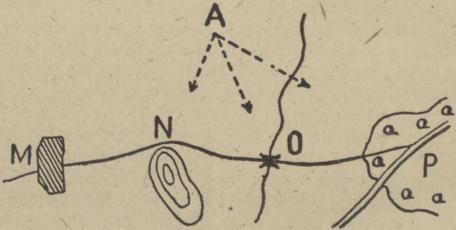
Fig. 52.
(Reconnoitring the road covers only certain details, e.g., its width, curves, gradients, and obstacles that prevent moving off to the sides. Point O is to be subjected to such examination so that the patrol must stop there for 5–10 minutes).
The three Red patrols are dispatched from A: Patrol I towards N, Patrol II towards O, and Patrol III towards P. They receive the order to observe the road and report to A about the appearance of the Whites and their activities. The departure time is regulated so that the White patrol reaches O at the same time as the Red Patrol II.
The exercise may proceed without any complications: one side reconnoitres the road, while the other reports on their work, and that is the end of it. However, complications of various kinds may arise if the patrols become aware of the situation and show some initiative.
For example, Patrol II, which first spots the Whites, observes them and concludes that the enemy is reconnoitring the road, which likely means their unit will travel this way. Will the Whites turn back, or will they proceed towards P? Therefore, on the one hand, they must notify the command at A, and on the other, Patrols I and III at N and P. Perhaps one of them, forewarned, will set an ambush and attack the Whites?
Meanwhile, the Whites have noticed the Reds, for instance, near O, from which they conclude that the road is under observation. Therefore, they must report this to M. However, it is possible that there are more Reds, and they might encounter them elsewhere, so they must warn the messenger about this and decide: either to return once more to N to check if there are enemy patrols there as well, and then return, or to continue reconnoitring the road all the way to P.
If the Whites turn back, Patrol II may set an ambush for them near N; if they proceed further, they might be surprised by an attack from Red Patrol III. Or perhaps they will spot the Reds near P? In that case, they will send a new messenger or messengers via a detour to M, while they themselves will wait in hiding for their own unit, posting guards well. Or perhaps they will manage to launch an attack on the Reds? etc. The events can unfold in the most varied ways, as the situations can change.
After the exercise, a debriefing follows. Victory is not decided by capturing a prisoner, but by whether, at a given moment, a good decision was made and whether, despite an unfavourable outcome, it was the best possible decision in that situation.
The road section is 2–3 km long. In the case of an ambush attack, the rules given for other exercises of the same type apply.
In this, as in any other exercise, the leader may omit all further explanations if the scouts are experienced and he wants them to assess the situation and make decisions independently; he may also provide even more detailed explanations than those given in the exercise.
Scan source: Polona / National Library of Poland, marked “Public domain”. View scan — PDF pages 212–214.
Metadata
Section titled “Metadata”- Type: game
- Traits: Not stated in the source
- Source: Zygmunt Wyrobek, Harcerz w polu: zabawy i gry terenowe (1946)
- Printed pages: 206–208 / PDF 212–214
- Digital edition: Digital edition · Source record
- Open the edition at the relevant page: p. 206
- Read the source text: hwp-105