Breaking the Telegraph Line
Translation details
Model:mistral-medium-2604.Translated text
Section titled “Translated text”Game marked with an asterisk in the book: more suitable for older scouts.
A road with telegraph poles runs through terrain that is perfectly suited on both sides for stalking and sudden attacks.
The Whites, with a strength of 2 patrols, occupy the road, stationing one scout at each pole; the rest remain in reserve. Their commander will decide whether to man all the poles or to station scouts at some of them in small groups.
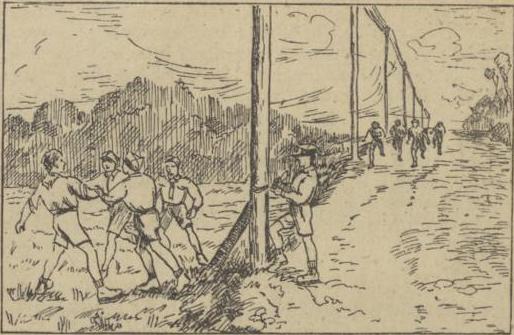
Fig. 45.
The Reds, with a strength of 1 patrol, must break the telegraph line. They succeed if they manage to wrap one pole with three ropes or scarves. However, the White defends the pole and can “kill” a Red by tearing the wool armband from their arm.
How does the exercise unfold under these general rules? The Whites, expecting an attack but not knowing from which direction it will come, send scouts in both directions. Each scout diligently reports their observations to the command: where the Reds are gathering or where they are heading. Based on this, the commander stealthily sends part of the reserve to the threatened points, where they wait for the enemy or force them to retreat with their numerical advantage, thus preventing the attack.
But the Reds are not idle either. They try to mislead the Whites, feigning false attacks, etc., so that at the right moment they can strike in the least expected place and wrap an unguarded pole. A whistle—rush to the rescue—but it is already too late. They also dare to attack a guarded spot: while one Red distracts the White, skillfully avoiding having their armband torn off, a second or even a third wraps the pole in the meantime. And who knows if the entire raid, though noisy and requiring the sacrifice of three, just to draw as much of the enemy as possible, is not also a feint? For suddenly, two Reds appear at a distant spot and wrap the undefended poles.
As can be seen, nothing here can be done independently. Everyone must be in constant contact; everything must be carried out according to a plan: lightning-fast assessment of the situation and lightning-fast action. And yet, they must not let their guard down, for after a failed attack, the next one might succeed.
Whoever completes their task within the designated time wins: the Reds if they wrap the poles as prescribed, the Whites if they prevent this.
This exercise can be varied in many ways; it can also be made more difficult for one side or the other. For example:
-
The defense will be more difficult if the exercise is set on such a long stretch of road that it is impossible to station a defender at every pole. Or:
-
The Reds can be declared the winners even if, in one raid, they wrap a pole only once or twice, and only on the third attempt do they wrap it three times. Or:
-
The task can be to wrap not one but three poles (each with one rope), and not simultaneously, but at any intervals. Or: “killing” occurs by touching a Red with the hand (easier than tearing off the wool armband). Or: it is allowed to untie a rope from the pole if it has not been wrapped three times, etc.
Only the defender can “kill,” but a rule can be added that the Reds must cease their work and retreat if the Whites appear at a given point in greater numbers.
Outside the road, the Reds retreat before the Whites, or vice versa: the Reds retreat if the Whites are equal in number, while the Whites retreat if the Reds have the advantage. However, it is also possible to allow mutual tearing of armbands on this terrain (but not on the road), etc.
Of course, a scout without an armband does not participate further in the exercise. With cleverness and some experience, the game can proceed very smoothly and develop in an engaging manner.
Scan source: Polona / National Library of Poland, marked “Public domain”. View scan — PDF pages 193–196.
Metadata
Section titled “Metadata”- Type: game
- Traits: Not stated in the source
- Source: Zygmunt Wyrobek, Harcerz w polu: zabawy i gry terenowe (1946)
- Printed pages: 187–190 / PDF 193–196
- Digital edition: Digital edition · Source record
- Open the edition at the relevant page: p. 187
- Read the source text: hwp-096