Attack on the Relay Post
Translation details
Model:mistral-medium-2604.Translated text
Section titled “Translated text”Game marked with an asterisk in the book: more suitable for older scouts.
At the assembly point, one white scout remains, while the entire patrol sets off in a designated direction toward a specified goal, located an hour’s march away. The march takes place partly along the road and partly across off-road terrain. Every 10–15 minutes, individual scouts (or pairs) are left in good hiding spots, thus creating a chain of intermediate relay stations through which dispatches will be sent to the receiving station. Eventually, the patrol leader arrives at the goal with a few remaining scouts. From there, at intervals (every 10–20 minutes), a courier is sent with a dispatch. This courier must locate the nearest station and relieve the scout hidden there, who will then carry the dispatch further to the next station. Dispatches must be numbered and signed by the patrol leader—they are carried in the shirt pocket.
So far, the task is simple and easy. However, from the assembly point, 20 minutes after the white patrol departs, the red patrol sets off. They only know that couriers with dispatches are moving in the area and that a relay post exists. But which route does it follow, and where are the individual stations? The reds must try to obtain this very information, for the goal is to intercept the dispatch, and even more so, to break the chain and prevent the transmission of messages.
Now it becomes clear how difficult the task is for the whites, for if even one hiding spot is discovered and the scout hidden there is captured, every approaching courier will fall into a trap. Moreover, instead of searching the area, the reds can discreetly follow the white patrol’s trail and thus discover the location of the stations. And what to do if the chain is broken—how to warn the others? Difficult situations may arise, and there is no end to them; one must be prepared for every surprise and immediately find remedies.
It will then become apparent whether the whites have their wits about them. Above all, each hiding spot must be well chosen, i.e., known to all couriers and easy to find, while also providing both adequate concealment and a good view of the surroundings. In this way, the courier will know what is happening not only around him but also near the previous and next stations (a hiding spot can even be in a tree).
Furthermore—all couriers should have established signals and always send them from cover so as not to reveal their presence. These do not need to be flag signals, i.e., conveying entire words (though that is also possible); simple signs will suffice, indicating the interruption of the post with the number of the destroyed station, the interception of a dispatch, an impending danger, the relocation of one station to another place due to the discovery of a hiding spot, etc. There should not be many such signals, but they must be clear.
Not all stations can see each other, as the terrain does not always allow it. Therefore, each courier must cautiously sneak toward the next station, using all possible cover, and approach it carefully, waiting for a signal that the way is clear, for he might walk into an ambush. Anyone who has had to leave the line must notify the previous station, or at least warn the approaching courier—in short, every important event must be communicated to the others.
The whites can more easily overcome all these difficulties if, instead of leaving one scout at each station, they leave two: one to relay the messages, the other to mend broken links. This is also how the exercise should be organized from the start.
A courier is taken prisoner by being stopped with the word: «Halt!» from a distance of 10 (15) paces (it is also permissible to allow direct capture by tearing off the badge from the shoulder, as both sides wear badges). The whites win if, within the designated time, they deliver two-thirds of the sent dispatches to the first assembly point. The number of dispatches is predetermined. A courier must not destroy a dispatch or refuse to hand it over.
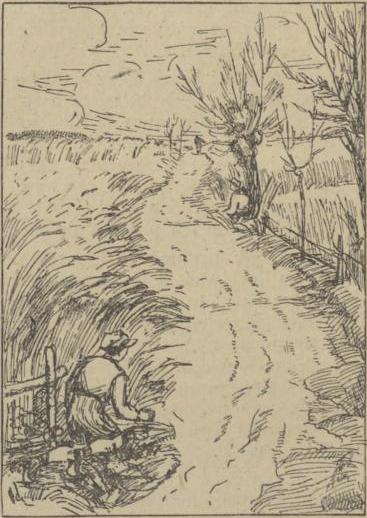
Fig. 44.
Source of scan: Polona / National Library of Poland, marked “Public domain”. View scan — PDF pages 190–193.
Metadata
Section titled “Metadata”- Type: game
- Traits: Not stated in the source
- Source: Zygmunt Wyrobek, Harcerz w polu: zabawy i gry terenowe (1946)
- Printed pages: 184–187 / PDF 190–193
- Digital edition: Digital edition · Source record
- Open the edition at the relevant page: p. 184
- Read the source text: hwp-095