For the Flags
Translation details
Model:mistral-medium-2604.Translated text
Section titled “Translated text”The exercise terrain is uneven, full of trees, bushes, etc., and is divided by a clear natural boundary, such as a road, path, or a row of trees, etc.; its natural side boundaries should also be marked (which must not be crossed during the exercise). However, this is rarely possible. Therefore, it is usually necessary to mark the dividing line with flags, with the outermost flags indicating the side boundaries.
The Whites and the Reds stand facing each other on either side of the central boundary and, in their respective areas, plant 3 flags each at a distance of 80–120 paces from the boundary, spaced 40 paces apart. The flags are placed in a line parallel to the boundary. The Whites attempt to sneak across the boundary, seize the flags, and bring them back to their camp.
Each scout may bring back only one flag per sortie. A raider may be taken prisoner. Since the Reds have the same task, both sides send some of their scouts beyond the boundary, while others remain in camp to defend their own flags. These defenders may stand no closer than 20 paces from a flag; otherwise, they are excluded from the game. The side that collects 5 flags in its camp wins. A captured flag is not planted in the ground unless it replaces a missing one.
Capturing a prisoner is done by touching them with a hand. A prisoner may only be taken within one’s own camp, never beyond the boundary in the opponent’s camp. The prisoner is then led to a designated prison area.
What will the course of the exercise be under these rules? For example, the Whites post guards near their flags. After a moment, a Red appears, crawling toward one of them. A guard spots him and blocks his path to force a retreat. The Red withdraws, leading the White away, while two more Reds emerge from the side. Before the guards can deal with them, the first Red reaches the flag (which the White is not allowed to approach). However, surrounded on all sides, he cannot seize it—he is neutralized for now. But since it is difficult to both guard and constantly watch for new enemies hiding behind bushes or rocks, the guards are caught off guard when two Reds suddenly appear and rush toward the nearest flag. The attack turns out to be a feint, but the surrounded Red takes advantage of it and escapes with the flag.
However, halfway back, he encounters two Whites who, hidden, form a second line of guards; they capture him and take the flag. Since the rule states that a flag taken within one’s own camp must be planted where it was captured, not on the original line, the Reds lose a man but bring the enemy flag closer to their camp, extending the Whites’ flag line and making their defense more difficult. This increases the chances of capturing more flags.
In this way, flags pass from one side to the other—one disappears, another is planted in its place—while at every step, one may encounter a lurking enemy. Thus, each scout sometimes crawls cautiously, using every cover to survey everything before taking another step, or sprints at full speed to reach a flag or, with a feigned attack, to help their comrades get to it.
New plans for real and feigned attacks constantly arise, where boldness and cunning triumph. Ultimately, one side has its 3 flags planted and 2 captured—and wins.
Each side has a judge to resolve disputes. It is advisable to plant twigs in the ground 20 paces from the flags to mark how close guards may approach.
Flags should not be hidden from the enemy. However, this is done (by planting them behind bushes, not in thickets) once scouts have gained sufficient experience in the game.
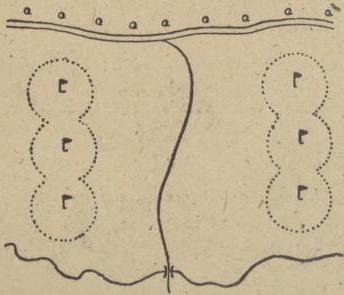 Fig. 40.
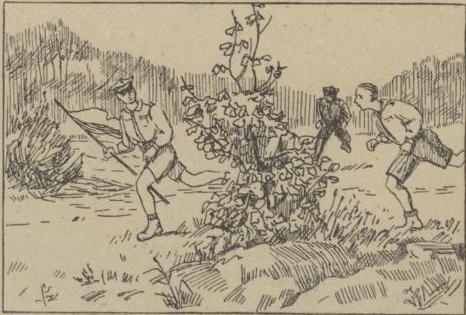 Fig. 41.
Source scan: Polona / National Library of Poland, marked “Public Domain”. View scan — PDF pages 169–172.
Metadata
Section titled “Metadata”- Type: game
- Traits: Not stated in the source
- Source: Zygmunt Wyrobek, Harcerz w polu: zabawy i gry terenowe (1946)
- Printed pages: 163–166 / PDF 169–172
- Digital edition: Digital edition · Source record
- Open the edition at the relevant page: p. 163
- Read the source text: hwp-085