Raid on a Bivouac
Translation details
Model:mistral-medium-2604.Translated text
Section titled “Translated text”a) The White patrol receives an order to launch a sudden raid on the Red patrol, which is bivouacked. If this exercise is not connected to another (e.g., the “step-by-step pursuit of the enemy” march, p. 72), meaning the Whites do not know the Reds’ location, the leader designates a fairly large section of terrain within which the Reds are bivouacked.
The Whites must therefore scout out the bivouac site. To do this, they send out individual scouts, who then bring back or send word—either verbally or in writing—possibly accompanied by a situational sketch.
The patrol then approaches stealthily from the side that allows them to get close without being noticed. If the Reds have not posted a guard, the raid may succeed, and the Whites will plant their flag in the middle of the bivouac as proof of victory. However, if there are guards and the sentinel sounds a whistle in time to warn the bivouacked Reds, the Reds will either quickly withdraw from the threatened point or take up a well-organized defensive position—and in that case, the raid has failed.
The sentinel may indeed give the signal, but too late, in which case his badge will be torn from his arm (see general rules of encounter), and similarly for a few separately approaching scouts. The Whites may still manage to plant their flag in the Reds’ unabandoned camp despite the warning.
Hence the lesson: a patrol should bivouac in a concealed location with a clear view of the surroundings, and it should always be surrounded by guards.
This exercise can also be conducted on a clear evening, by moonlight; defense is then more difficult, and the raid easier, but locating the patrol is much harder.
The Red patrol must not know about the impending raid; the leader bivouacs with this patrol and decides the outcome in favor of one side.
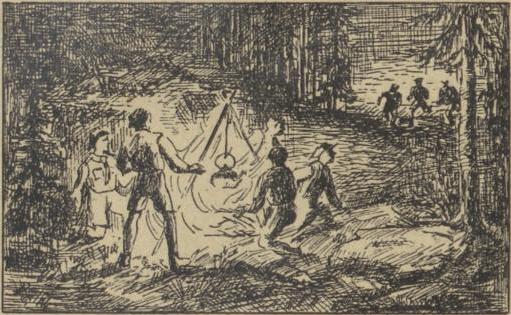
Fig. 37.
b) The raid can also be organized differently. Here, the Reds are three times stronger than the Whites. The Whites know the threat they face, and the Reds know the Whites’ bivouac location, as it has been marked on a map for them.
The Reds win if they manage to surround the bivouac and simultaneously attack the Whites with all their groups. They must be divided into groups: two groups of one patrol each and two groups of half a patrol each (no smaller). A loud signal marks the start of the raid.
The Whites (who have the strength of one patrol) win if they manage to attack a group weaker than themselves before the signal, as this is considered to have broken the encircling ring. They must retreat if facing a group of equal strength.
Of course, impartial observers must confirm whether the signal for the raid was given only when the bivouac was actually surrounded.
Since it is difficult to determine from a distance the size of the group one is dealing with, the Reds must raise a flag during a White raid: a red flag if it is a full patrol, or, for example, a yellow flag if it is only half a patrol.
Scan source: Polona / National Library of Poland, marked “Public domain”. View scan — PDF pages 157–159.
Metadata
Section titled “Metadata”- Type: game
- Traits: Not stated in the source
- Source: Zygmunt Wyrobek, Harcerz w polu: zabawy i gry terenowe (1946)
- Printed pages: 151–153 / PDF 157–159
- Digital edition: Digital edition · Source record
- Open the edition at the relevant page: p. 151
- Read the source text: hwp-077