Terrain Reconnaissance
Translation details
Model:mistral-medium-2604.Translated text
Section titled “Translated text”Game marked with an asterisk in the book: more suitable for older scouts.
Terrain reconnaissance is the act of personally verifying whether a given section of terrain is suitable for a specific purpose. It is conducted because maps do not contain all details (which, moreover, are subject to constant change), and the terrain itself changes in appearance depending on the season, weather conditions, etc. Additionally, for certain purposes, it is necessary to gather data that a map simply does not provide.
When practicing terrain reconnaissance, avoid complicated tasks; instead, assign simple, concrete tasks. The goal is for the scout to learn to focus their attention on the specific details that need to be identified in a given situation.
A reconnaissance report primarily consists of creating a cartographic sketch, marking the elements that were to be investigated, with a supplementary description providing further clarification. Such a report should be clear and concise. During reconnaissance, a map should be used; if it cannot be taken along, at least “study” the map before the march, which will not only make navigation easier but also help in locating the necessary points and terrain details.
In many of the exercises provided, this “reconnaissance” of the terrain is a component part.
However, terrain reconnaissance itself can also be a separate exercise or the most important part of one.
As with any other type of exercise, the difficulty of reconnaissance should be graded for the scouts.
a) Scouts first complete a sketch of a terrain section based on a map, then supplement it in the field by drawing in all the relevant details, marking some with conventional symbols, and adding a “legend”—i.e., an explanation and verbal supplement to the sketch. This is done under the supervision and guidance of the leader, who provides precise instructions each time on what and in which direction to investigate.
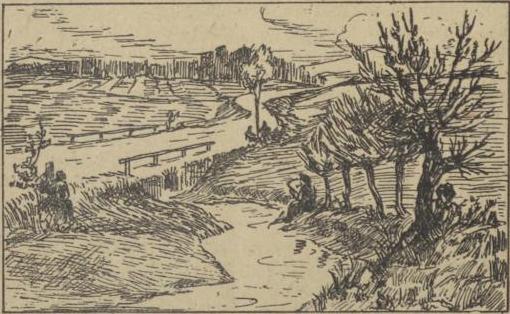
Fig. 36.
b) Next, scouts practice sketching using various methods. Once they have gained some proficiency, they are given different terrain reconnaissance tasks to complete independently, such as investigating a railway line, road, river and its fords, bridges, forest, swamp, settlement as a potential quarters location, terrain for a camp, or an ambush site, etc. (Relevant manuals provide detailed guidance on what details to pay attention to in these cases). All scouts may receive the same task, each completing it separately, after which the results are compared and discussed.
c) Finally, there are exercises in terrain reconnaissance where the patrol provides protection for the sketch artist. This task for the patrol comes to the forefront, especially when the investigator is not stationary but moves across the entire area being surveyed. In such cases, the patrol’s duty is to guard the investigator against danger throughout the process. To create realistic conditions, an opposing patrol is deployed in the vicinity of the surveyed terrain. Their orders might be: “A patrol is moving around area X, likely reconnoitering the terrain. Investigate what they are doing and prevent them from completing their task.” Now, a simple terrain reconnaissance turns into a more complex exercise. The white patrol, which is protecting the investigator, hides from the red patrol, continues the reconnaissance when the danger passes, and avoids engagement, as the primary goal is to survey the terrain. In short, they strive not to reveal their presence, communicating quietly with signals; if the enemy gets on their trail, they attempt to mislead and divert them. The red patrol also tries to fulfill its orders—one tracks, the other hides, and the winner is the one who completes the assigned task within the specified time.
Scan source: Polona / National Library of Poland, marked “Public Domain”. View scan — PDF pages 153–155.
Metadata
Section titled “Metadata”- Type: game
- Traits: Not stated in the source
- Source: Zygmunt Wyrobek, Harcerz w polu: zabawy i gry terenowe (1946)
- Printed pages: 147–149 / PDF 153–155
- Digital edition: Digital edition · Source record
- Open the edition at the relevant page: p. 147
- Read the source text: hwp-074