Who is Closer?
Translation details
Model:mistral-medium-2604.Translated text
Section titled “Translated text”A sentinel stands on a hill clearly visible even in the evening. Scouts approach from all sides, each trying to get as close as possible. When a scout believes they are close enough, they make a sign to indicate they have reached that spot. Then, they carefully retreat (or reveal themselves, if ordered to do so). However, the sentinel listens intently, and if they hear a suspicious rustle, they whistle. Everyone freezes, and the patrol leader checks whether an enemy is indeed hiding in the spot indicated by the sentinel. The leader then either excludes the scout, measuring the distance from the sentinel, or signals for the others to continue advancing.
After the designated time has passed or a signal is given that everyone has completed their task, it is checked whose sign is closest to the sentinel. Additionally, it is noted whose signs are no farther than 10 meters from the sentinel, as this is considered a good performance.
Scouts should approach one at a time and from all sides, not in a group, as it can be difficult to determine who is at fault in such cases.
If two patrols are competing, the opposing patrol provides the sentinel, and the results are compared afterward. Alternatively, scouts from both patrols may approach simultaneously, with one of the patrol leaders acting as the sentinel. When awarding victory, the leader considers both the number of those eliminated and which patrol, overall, got closer.
A good variation of this game is to give the sentinel an electric torch to illuminate the playing area. In this case, the approaching time is set, for example, to 15–20 minutes, after which a signal is given to end the game. Everyone remains in their place, and it is determined how many were discovered and who got closest.
Scan source: Polona / National Library of Poland, marked “Public Domain”. View scan — PDF pages 138–139.
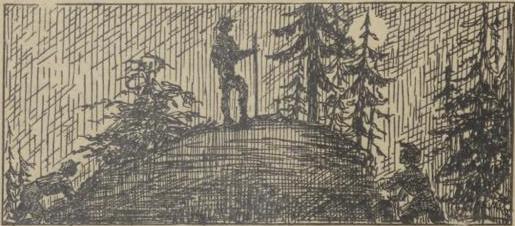
Fig. 33.
Metadata
Section titled “Metadata”- Type: game
- Traits: Not stated in the source
- Source: Zygmunt Wyrobek, Harcerz w polu: zabawy i gry terenowe (1946)
- Printed pages: 132–133 / PDF 138–139
- Digital edition: Digital edition · Source record
- Open the edition at the relevant page: p. 132
- Read the source text: hwp-062