From Outpost to Outpost
Translation details
Model:mistral-medium-2604.Translated text
Section titled “Translated text”At the assembly point, the red patrol remains. The white patrol sets out and, every few hundred paces, leaves a small group of scouts. In one spot, three remain; in another, one; then two, and so on. The patrol’s route passes through varied terrain and in different directions, such that the last group is approximately the same distance from the assembly point as the first.
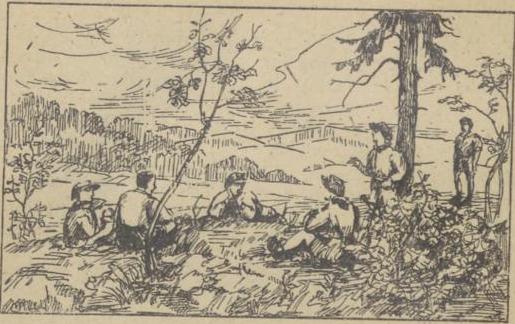
Fig. 25.
Once the setup is complete, the red scouts are sent out one by one, each at three-minute intervals. Each must visit all the outposts, starting from the last and ending at the first, then return to the assembly point. When a messenger approaches, the outpost assumes a specific position or performs a certain action, maintaining the same posture or movements for every messenger. (For example, one sits cross-legged and writes, another wipes his brow with a handkerchief, a third kindles a fire, etc.). Upon arrival, the messenger receives instructions on where to find the next group (e.g., “Go along the stream until you reach a solitary alder, then turn right along the boundary to the road; beyond the road, behind the birch grove, is the next outpost”) and immediately sets off, committing to memory the posture and actions of all members of the outpost. Upon reaching the second outpost, he receives further directions, and so on, until he returns to the assembly point. The patrol leader records the departure and return times of each scout.
When all have returned, a series of questions follows, such as: How many were in group 2? How were the scouts dressed in group 3? What was the posture of the people in group 1? What were they doing in group 4? Each scout writes his answers on a piece of paper and submits them to the patrol leader. After the outposts return at a given signal, the accuracy of the answers is verified. The winner is the one who provides the best answers, but he must also have a good time for visiting the outposts; otherwise, he is moved down one place in the ranking or even disqualified from the results. (The leader knows the distances between outposts and sets a minimum time required to complete the circuit).
The same process is then repeated with the red scouts as outposts and the white scouts as messengers. If this is a competition between two patrols, half of the white and half of the red scouts are stationed as outposts, while the rest take turns visiting them. Suppose a white scout gives the best answer. Then the scouts switch roles, and if a white scout again proves the best, the whites win; otherwise, the match is undecided.
Scouts should be reminded that the instructions given to messengers must be exactly the same for each one. Messengers travel in the opposite direction from the one in which the outposts were placed, as otherwise they could not receive directions for the next leg of their journey. When setting up the groups a second time, the same distances must be maintained between them.
Scan source: Polona / National Library of Poland, marked “Public domain”. View scan — PDF pages 93–95.
Metadata
Section titled “Metadata”- Type: game
- Traits: Not stated in the source
- Source: Zygmunt Wyrobek, Harcerz w polu: zabawy i gry terenowe (1946)
- Printed pages: 87–89 / PDF 93–95
- Digital edition: Digital edition · Source record
- Open the edition at the relevant page: p. 87
- Read the source text: hwp-029