Unaware of Danger
Translation details
Model:mistral-medium-2604.Translated text
Section titled “Translated text”Game marked with an asterisk in the book: more suitable for older scouts.
Two white patrols are sent towards the river to check if bridges m and n are free of the enemy.
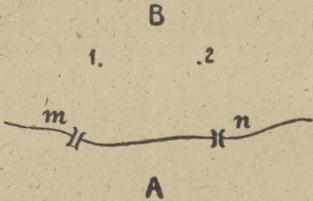
Fig. 51.
Written reports about this should be sent to point B, then the river crossings should be occupied, and any approach of the reds should be reported.
After the whites have left, and secretly from them, the leader positions two red patrols at points 1 and 2 and orders them to report in writing to A that the white unit is at B. (Both at point A and B, a scout with a flag stands to receive the reports).
The red messengers are sent 15–20 minutes after the whites have left (when it is assumed that the whites have already taken the bridges and sent reports to B). Twenty minutes after them, both red patrols set out towards the bridges, one to the right bridge, the other to the left, in order to reach their unit at A. (If there are no bridges, the river can be replaced by a road, on which two flags are planted at two sufficiently distant points to indicate that patrols may only cross the road there).
In this way, both sides are unaware that the enemy is active in their vicinity or has taken a position behind their backs. This will lead to various surprises.
Thus, on the one hand, the white messengers returning from the bridges will easily fall into the hands of the reds; on the other hand, the red messengers will even more easily be captured by the whites in an ambush before or beyond the bridge. Will all four be taken prisoner? Or will one of them manage to slip through the enemy position and deliver the message?
The red patrols heading towards A will also fall into a trap if the whites hide well and spot them in time, or if they previously capture a red messenger and deduce from this that the entire patrol will soon arrive.
However, it is also possible that the reds will be warned in time by their messenger, who managed to retreat from the dangerous point, or they will orient themselves in the situation and then either reach the other side with losses or join the second patrol to force a crossing through one of the bridges with combined forces.
The leader will award victory to one side not based on the number of prisoners, but based on an assessment of how the side behaved in the changed situation and whether it took the most appropriate steps at the given moment.
Before the exercise, the rules of encounter are established, whether it is tearing off armbands, or the smaller number retreating before the larger, etc. Special attention should be paid to distances and adjusting the timing of sending messengers and the march accordingly.
The terrain should be uneven and non-transparent, which is less necessary if the exercise takes place in the evening.
Source of scan: Polona / National Library of Poland, marked “Public Domain”. View scan — PDF pages 210–212.
Metadata
Section titled “Metadata”- Type: game
- Traits: Not stated in the source
- Source: Zygmunt Wyrobek, Harcerz w polu: zabawy i gry terenowe (1946)
- Printed pages: 204–206 / PDF 210–212
- Digital edition: Digital edition · Source record
- Open the edition at the relevant page: p. 204
- Read the source text: hwp-104