Without an Opponent
Translation details
Model:mistral-medium-2604.Translated text
Section titled “Translated text”Game marked with an asterisk in the book: more suitable for older scouts.
The exercise takes place in the evening. The white patrol receives the order to reach point A to determine whether it is free of reds. They must proceed very cautiously, and if they encounter the enemy either on the way to this point or on the return, they must bypass them and reach point B unnoticed, from which they set out.
After their departure, two white patrols, each consisting of 4–6 people, take up positions at the edge of the forest at points m and n, 200–400 paces apart, while a third patrol serves as a communication link between them, patrolling along the forest’s edge; all have the order to repel red patrols and prevent them from entering the forest. Reports are sent to point B.
Meanwhile, there are no reds at all; only four white patrols are participating in the exercise. However, the guards are unaware of this and constantly expect the enemy from the direction of A.
Now, interesting situations may arise. The first patrol cautiously approaches A, checks that there are no reds there, and returns even more cautiously, convinced that they will encounter them at any moment.
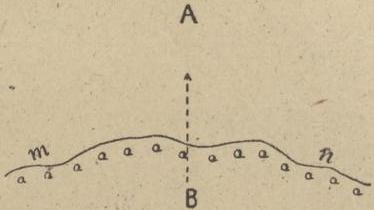
Fig. 49.
Thus, they reach the forest and observe it before entering deeper. They notice one or another outpost or a patrol moving along the forest. In the darkness, it is difficult to distinguish who they are dealing with, and since the order states that they must pass unnoticed to B, they take advantage of the opportunity and, at the right place and moment, sneak into the forest. In this way, they may reach point B, still convinced that they have broken through the red line. The leader gives the signal to assemble, and then everything becomes clear: the carelessness of the guards and the unnecessary sneaking through their own line instead of first determining who is defending the forest. A lesson for the future.
It may also happen that an outpost or patrol notices the approaching group and either drives them away or sets an ambush, etc. However, it is only later (if at all) that they realize they were dealing with a friend, that they have taken part of their own into captivity, or scattered some of them in all directions. Whatever happens, such an experience teaches that not every approaching figure must be seen as an enemy.
All wear armbands of the same color. The guarding patrols must be kept unaware of whether and where the first patrol has gone and what color it is.
Scan source: Polona / National Library of Poland, marked “Public domain”. View scan — PDF pages 206–208.
Metadata
Section titled “Metadata”- Type: game
- Traits: Not stated in the source
- Source: Zygmunt Wyrobek, Harcerz w polu: zabawy i gry terenowe (1946)
- Printed pages: 200–202 / PDF 206–208
- Digital edition: Digital edition · Source record
- Open the edition at the relevant page: p. 200
- Read the source text: hwp-102