Avoiding the Enemy
Translation details
Model:mistral-medium-2604.Translated text
Section titled “Translated text”Game marked with an asterisk in the book: more suitable for older scouts.
A scout with one signal flag indicates an outpost; with two, a larger unit. Both sides are aware of this.
Along a stream, 3 white outposts are stationed, with the middle one occupying the bridge. (If there is no stream, a road is chosen.) The white patrol must scout the area in front of the outposts, reach settlement A, and check if it is occupied by the reds. Reports must be sent to point B, located behind the middle outpost.
The red patrol, having left their unit in A, sets out to inspect the bridge. If the situation allows, they are to wait for their unit near the bridge.
The leader sends both patrols at such a time that they meet in the middle of the space between the bridge and settlement A. When the reds encounter the whites, they should not engage in any skirmishes but rather avoid them, as their task is to inspect the bridge. However, they are puzzled by the presence of an enemy patrol in this area, so they send a report about encountering the enemy at that location and continue onward. At the bridge, they notice the presence of an outpost—this is already more important information, as it reveals the enemy’s position. Therefore, a second report is sent, but since it is very important and the whites are lurking behind them, it is dispatched via two messengers on different routes. The patrol then locates the positions of the remaining outposts and, given the changed situation, decides not to wait for their own unit but instead to go toward A to personally report the new developments.
The whites, upon encountering the reds, should also not be distracted from their proper task: verifying whether the red unit is in A. They will therefore send a messenger with news of the encounter with the reds and continue on their way. However, they should assume that messengers will be sent to A by the reds and do their best to intercept them.
Will both patrols carry out all of this? Or will a chase begin, with the original task forgotten—the very task that must be fulfilled above all? The leader will assess the conduct of both sides and award priority to the one that, having recognized the changed situation, chose the best course of action.
Scan source: Polona / National Library of Poland, marked “Public domain”. View scan — PDF pages 204–206.
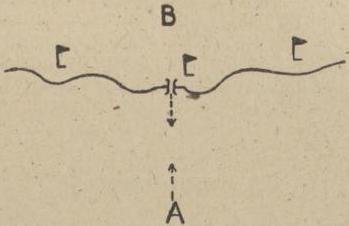
Fig. 48.
Metadata
Section titled “Metadata”- Type: game
- Traits: Not stated in the source
- Source: Zygmunt Wyrobek, Harcerz w polu: zabawy i gry terenowe (1946)
- Printed pages: 198–200 / PDF 204–206
- Digital edition: Digital edition · Source record
- Open the edition at the relevant page: p. 198
- Read the source text: hwp-101