Camp in the Forest
Translation details
Model:mistral-medium-2604.Translated text
Section titled “Translated text”Game marked with an asterisk in the book: more suitable for older scouts.
The exercise takes place on a clear evening. The Whites are camping in the forest; guards are posted around. The camp consists of a planted flag with a few scouts by a campfire or, if fires cannot be lit, by a lantern. The area in front of the forest is scouted by patrols from the direction where the Reds are expected to approach.
The Reds are stationed at point A, and having learned of the Whites’ camp in the forest, they send two patrols in the directions m—n with orders to search the area and locate the Whites’ position.
Sooner or later, the opposing patrols will encounter each other. The Reds’ primary task is to locate the camp, so they will avoid combat, the outcome of which is uncertain; instead, they will try to evade the Whites’ sight. The Whites, on the other hand, aim to prevent the Reds from entering the forest, so upon confirming the presence of an enemy patrol, they will attempt to cut off their path and set an ambush. If the Reds spot a White, they will follow him closely, as he may lead them to the camp, and if circumstances are favorable, they may even attack him. The White will return not by the shortest route but by a roundabout path to avoid revealing the camp.
Since the Whites have three patrols (one at the camp, one on guard duty, one on reconnaissance) and the Reds have two or three, and the exercise takes place in the evening, one side must wear distinguishing badges on their caps or shoulders (in addition to the colored armbands), and both sides must have their own challenge and password. The patrols may be small, consisting of just a few scouts.
The Reds must send reports to point A, behind the line m—n. Additionally, the rule is that the Whites change their roles at regular intervals (every ½–1 hour), meaning that those on patrol go to the camp or on guard duty, and others take their place.
If the guards raise an alarm (not before), the Whites are allowed to change the camp’s location (always within a designated area), making it harder for the Reds to find it. However, they should leave one or two scouts behind to explain the situation to returning patrols.
Everything is done quietly; the Red patrols in particular try to move as silently as possible and conduct reconnaissance as cautiously as possible to avoid detection. However, since the exercise takes place in the dark, a series of surprises will inevitably arise.
At a set time, the exercise ends with an agreed signal. Locating the camp or preventing its discovery constitutes victory.
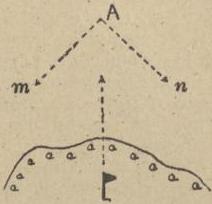
Fig. 47.
Source of scan: Polona / National Library of Poland, marked “Public domain”. View scan — PDF pages 203–204.
Metadata
Section titled “Metadata”- Type: game
- Traits: Not stated in the source
- Source: Zygmunt Wyrobek, Harcerz w polu: zabawy i gry terenowe (1946)
- Printed pages: 197–198 / PDF 203–204
- Digital edition: Digital edition · Source record
- Open the edition at the relevant page: p. 197
- Read the source text: hwp-100