Transport
Translation details
Model:mistral-medium-2604.Translated text
Section titled “Translated text”Game marked with an asterisk in the book: more suitable for older scouts.
The White Patrol escorts a cart, which must be delivered to a designated location several kilometers from the starting point. The cart is a type of stretcher made from scout staves. Specifically, two staves are connected by a crossbar, covered with tent canvas, a cape, etc., and everything is securely tied. At one end of the stretcher, a rope is attached, by which it is pulled: the front end is raised, while the rear end drags along the ground.
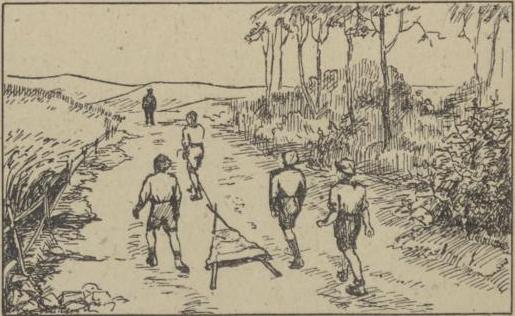
Fig. 46.
Three enemy patrols—Red, Blue, and Green—know where and when the White Patrol departs and where it is heading, but they do not know the route it will take. They therefore try to track the Whites’ path so they can ambush them at the right moment and seize the cart.
The Whites, however, do not forget they are moving through enemy territory and what dangers await them. Thus, part of the patrol escorts the cart, while another part scouts the terrain and reports any threats to the patrol leader, who then takes all defensive measures, even changing the route to avoid dangerous areas.
The Whites move along various paths, sometimes advancing quickly, sometimes retreating; but since three patrols lie in wait for them, they will sooner or later encounter an ambush, and it is doubtful whether they can avoid an attack. At least they have the consolation that the enemy patrols are not allowed to join forces, so they are only ever threatened by one patrol at a time.
What happens in case of an attack? The attackers, say the Reds, will capture the cart if they manage to throw their flag onto the stretcher. However, all scouts wear a woolen armband of their patrol’s color around their left arm, and anyone who has it torn off is considered killed—whether defender or attacker. Additionally, if the scout carrying the flag is even touched by one of the defenders, the attack is considered repelled along the entire line (judge’s whistle), and it can only be repeated in another location. Thus, both defenders and attackers suffer losses during an attack, and after a successful defense or a successful attack, it becomes harder for both sides to defend against the remaining patrols.
If the Reds manage to throw their flag onto the stretcher, the judge blows a whistle to signal that the attack succeeded (the judge, wearing a white armband, always accompanies the transport patrol—ideally, there should be two judges). The Reds then take over the role of the escort and attempt to deliver the cart to the destination despite attacks from the Blues, Greens, and even the Whites, who may try to retake it.
Ultimately, the patrol that succeeds in delivering the cart to its destination wins.
This exercise provides an opportunity, on one hand, for skillful and cautious terrain reconnaissance (since each scout on reconnaissance may fall into an ambush), for rapidly assessing the situation in case of an attack, and for making quick decisions amid constant surprises. On the other hand, it allows for tracking the escort’s march, using the terrain for cover and ambushes, and continuously adapting to changes in the transport’s route by maintaining constant contact with it.
All tricks are permitted except disguising oneself, as long as the flag is thrown onto the cart.
This exercise requires scouts to demonstrate particular discipline. Since hand-to-hand encounters occur, any scout whose armband is torn off must immediately withdraw from the exercise: they place their scarf on their shoulder and proceed to the assembly point, which is the destination where the transport is heading. Judges must strictly enforce the rules and compliance with the encounter regulations.
The rules can also be modified slightly. For example:
- After capturing the cart, the defeated patrol may be eliminated from the exercise;
- The destination may be known only to the transport patrol, which, if the cart is taken from them, reveals it to the victor and then withdraws;
- The cart must be delivered within a specified time, etc.
Scan source: Polona / National Library of Poland, marked “Public Domain”. View scan — PDF pages 200–202.
Metadata
Section titled “Metadata”- Type: game
- Traits: Not stated in the source
- Source: Zygmunt Wyrobek, Harcerz w polu: zabawy i gry terenowe (1946)
- Printed pages: 194–196 / PDF 200–202
- Digital edition: Digital edition · Source record
- Open the edition at the relevant page: p. 194
- Read the source text: hwp-099