From the Nest
Translation details
Model:mistral-medium-2604.Translated text
Section titled “Translated text”Game marked with an asterisk in the book: more suitable for older scouts.
The leader points out to one scout the place where he must hide the flag. No one knows this location. The scout sets off from point A, taking a winding path through varied terrain to make tracking difficult, but he carefully marks his route with agreed-upon signs. With him go three neutrals, who, after the flag is hidden, establish a boundary around the hiding spot with a radius of 100 to 300 paces. They do this by making rough sketches in which they mark the surrounding noticeable terrain features, and where necessary, they mark this boundary, e.g., with chalk on the door of a hut standing there. The entire area should be suitable for concealment and stealth.
Three quarters of an hour later, two scouts from each patrol set off, following the marked trail to find the flag. Each pair tracks for themselves, and cleverly, so as not to make the work easier for rivals from other patrols. Whoever reaches the flag must not take it; instead, they take only a card with the name of their patrol (there is a card for each of the seekers at the flag) and tries to deliver it to the leader, who waits for this at a location known to all, point B, several hundred paces away from the hiding spot.
Meanwhile, the patrols follow at a distance behind the trackers, keeping them in sight from afar. It is not allowed to pass members of one’s own patrol, but it is allowed to pass others. They do not necessarily follow the trail, as this might show the way to others—however, they always move in such a way as not to lose sight of their own.
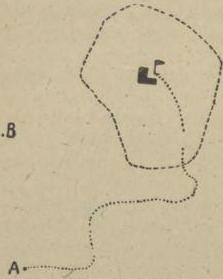
Fig. 42.
When they reach the boundary, which they are no longer allowed to cross, they receive the sketches from the neutral who waits for them there. Anyone who crosses the boundary during the exercise has their badge torn from their arm and is excluded from the exercise.
Now the actual exercise begins. Each patrol tries to catch the envoys of other patrols when they are on their way back to the leader (of course, after they have passed the boundary, as patrols are not allowed to cross it). By doing so, they eliminate their rivals’ own messengers, thus making it easier for their own to win. A captured envoy must surrender the card taken at the flag.
Of course, individual patrols move along the boundary, set ambushes for the sneaking opponent, block their path, etc., as long as they prevent the delivery of the card to the leader (the method of taking prisoners should be established based on the rules of the encounter).
However, one must not interfere with the capture of one’s own messengers or rescue them; likewise, one must not take prisoners other than enemy messengers. On the other hand, one may warn their own, inform them of enemy positions, point out a clear path, etc.
The patrol that brings the most cards within the designated time wins.
Those searching for the flag must have special badges, different for each patrol.
The boundary around the hiding spot can be closer or farther from it, depending on the scouts’ proficiency.
Scan source: Polona / National Library of Poland, marked “Public domain”. View scan — PDF pages 177–179.
Metadata
Section titled “Metadata”- Type: game
- Traits: Not stated in the source
- Source: Zygmunt Wyrobek, Harcerz w polu: zabawy i gry terenowe (1946)
- Printed pages: 171–173 / PDF 177–179
- Digital edition: Digital edition · Source record
- Open the edition at the relevant page: p. 171
- Read the source text: hwp-088