Ambush
Translation details
Model:mistral-medium-2604.Translated text
Section titled “Translated text”A patrol should, as far as possible, not return by the same route it took to go on reconnaissance. This is one of the principles of conducting reconnaissance. Why? The following exercise provides the answer.
The White patrol receives an order to reach point N, investigate whether there is a small bridge over the stream at that location, and send a report about it. Then, it must examine the width of the stream, its bed, banks, etc., over a distance of 300 paces, and return to M, from where it set out. (Note: the order may be different). The route passes through mixed terrain, which is in places impassable. After the Whites have left, and without their knowledge, the Reds receive an order to set up an ambush on the M—N route for both the returning messenger and the entire White patrol. It is rare for the messenger not to return by the same, already known, and thus most convenient route, and he will certainly fall into the ambush. The same will happen to the White patrol if it does not choose a different return route. Part of the patrol will be captured (there are more Reds), and the rest will be scattered. (Capture can be done by touching with the hand; the captured person is not allowed to escape). In what way and where will they regroup? Was a meeting point designated? Did the patrol leader control the situation, give the signal to scatter, and withdraw skillfully from the ambush? Did the Whites, walking carelessly without a guard, fall into the ambush, or did they discover it in time?
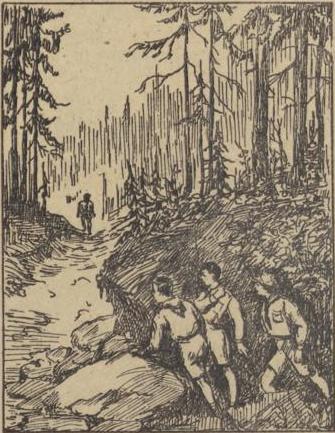
Fig. 38.
All of this will be the subject of a discussion, and at the same time, it will make both the messenger and the rest of the Whites more cautious in the future.
In general, an ambush can be used in various other exercises as a variation, where the patrol may know about the ambush but not its location, or it may be a surprise for the patrol.
Usually, the following rule is given for encounters: the ambush has failed if it is discovered in time, and conversely, the patrol loses if it is unexpectedly surrounded.
In such cases, hand-to-hand combat, involving the removal of the “combat ribbon,” should be avoided, as it leads to chaotic tugging and confusion, in which it is also difficult to determine who has won.
Source of scan: Polona / National Library of Poland, marked “Public domain”. View scan — PDF pages 162–164.
Metadata
Section titled “Metadata”- Type: game
- Traits: Not stated in the source
- Source: Zygmunt Wyrobek, Harcerz w polu: zabawy i gry terenowe (1946)
- Printed pages: 156–158 / PDF 162–164
- Digital edition: Digital edition · Source record
- Open the edition at the relevant page: p. 156
- Read the source text: hwp-080