False Trails
Translation details
Model:mistral-medium-2604.Translated text
Section titled “Translated text”It is possible to make tracking more difficult by laying false trails. Specifically, branches are created from the true trail, marked with scraps of paper of the same color, but ending at a certain distance with an agreed-upon sign indicating that the trail is false (e.g., a clearly visible chalk cross).
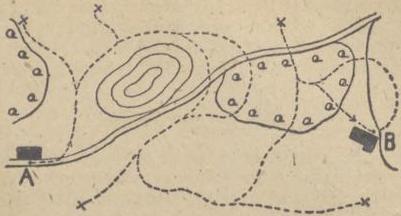
Fig. 31.
Additionally, branches can be made that later reconnect with the true trail, meaning they are genuine but lead a longer route to the destination than the true trail.
As a result of such trail arrangements, the scout patrol must split up at every fork in the trails, because if the entire patrol follows a false trail or takes a side trail instead of the true one, they will unnecessarily cover extra distance and waste time.
In this exercise, patrols can be sent out one after another every 15 minutes, with the winner being the one with the best time—or all patrols can be released at once. With rivals close behind, scouts of the same patrol then communicate with each other using agreed-upon shouts or signals to inform their own group whether they have found a good or bad trail, and on the other hand, to mislead the competitor following the patrol’s search and lead them onto a false trail. Much often depends on the cleverness and ingenuity of those tracking. Collecting or destroying trails is, of course, not allowed.
Where suitable terrain exists, the described tracking exercises can also be adapted by marking trails with irons attached to the soles of shoes. Such an iron leaves a trace that is distinctly different from ordinary footwear marks (a circle, several crosses, a bird drawing, etc.).
Scan source: Polona / National Library of Poland, marked “Public domain”. View scan — PDF pages 126–128.
Metadata
Section titled “Metadata”- Type: game
- Traits: Not stated in the source
- Source: Zygmunt Wyrobek, Harcerz w polu: zabawy i gry terenowe (1946)
- Printed pages: 120–122 / PDF 126–128
- Digital edition: Digital edition · Source record
- Open the edition at the relevant page: p. 120
- Read the source text: hwp-053