Reading Trails
Translation details
Model:mistral-medium-2604.Translated text
Section titled “Translated text”The art of drawing conclusions from reading tracks is just as important as the skill of tracking itself. Tracks are merely the material from which one builds, i.e., derives the appropriate conclusions.
One scout walks across terrain where visible tracks remain. At intervals, he changes his gait
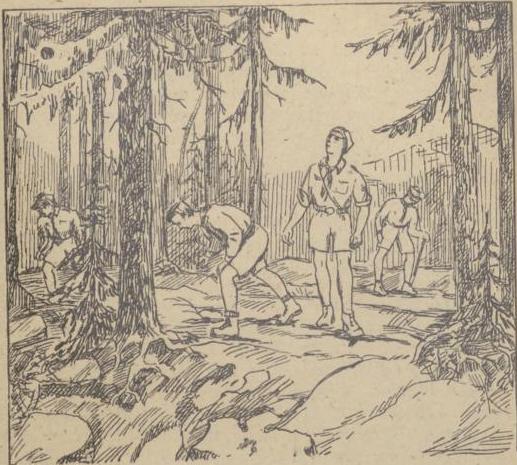
Fig. 30.
or performs certain actions strictly according to the patrol leader’s instructions. For example, in one place he makes a large leap, in another he limps heavily on his right leg, then he sits on the ground, removes one shoe, and continues walking barefoot on one foot; elsewhere, he crawls on his knees, etc. After a quarter of an hour, the patrol sets off along the tracks and must deduce, from the various changes in the trail, what the tracked scout did at each location.
Such tracks work particularly well in snow.
Scan source: Polona / National Library of Poland, marked “Public domain”. View scan — PDF pages 122–123.
Metadata
Section titled “Metadata”- Type: game
- Traits: Not stated in the source
- Source: Zygmunt Wyrobek, Harcerz w polu: zabawy i gry terenowe (1946)
- Printed pages: 116–117 / PDF 122–123
- Digital edition: Digital edition · Source record
- Open the edition at the relevant page: p. 116
- Read the source text: hwp-051