Disappearing Heads
Translation details
Model:mistral-medium-2604.Translated text
Section titled “Translated text”In a hidden spot, in a ravine or on a hillside, a scout patrol (in this case, 8 scouts) takes position, while the patrol leader stands at the edge of the ravine with a whistle and a flag in hand. The wings of the hiding place, which is several dozen paces long, are marked with clearly visible distant signs (flags). At a distance of 300–500 paces, another patrol stands similarly hidden, with its patrol leader visible and holding a flag. The first patrol will appear at intervals in various formations, while the second will observe. The patrol leader has a sheet with 8–10 consecutive formation changes noted. For example:
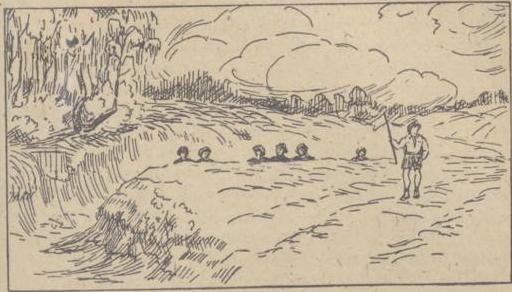
Fig. 29.
- Eight heads in a 3—2—1—2 formation
- Six heads in a 1—1—2—2 formation
- Five heads, with three more joining after 1 minute
- Six heads, then two disappear, and two new ones appear on the flank, etc.
On the patrol leader’s command, the scouts line up along the ravine in the first formation and poke their heads out so that they can clearly see the opposing patrol leader in full height. Then, a whistle and a flag signal toward the opponent to draw their attention. At this moment, the second patrol emerges from its ravine and observes the first for 2 minutes, with each scout noting the heads they see, as shown in the example. After two minutes, another whistle sounds, and everything disappears. Next, the patrol leader arranges the scouts for the second change (according to the diagram on the sheet), followed by another whistle and flag signal, observation for 2 minutes, then the third change (during which the heads are observed for 1 minute as they appear, and for the second minute, those that have joined are also observed—similarly for the 4th change), and so on, until all changes are completed. Now, the roles are reversed: the second patrol appears according to its own sheet, and the first observes. After the exercise, both patrols gather and check the accuracy of their observations based on the submitted sheets. The patrol with fewer errors wins.
The exercise can be made easier by reducing the distance, having the scouts poke their heads out a bit higher, or keeping the formation unchanged for the full 2 minutes of observation (without removing some and adding others, etc.). Conversely, it can also be made more difficult in various ways. In any case, the edge of the ravine should be smooth, not overgrown with tall grass, which would make it difficult to spot a head.
Source scan: Polona / National Library of Poland, marked “Public Domain”. View scan — PDF pages 114–116.
Metadata
Section titled “Metadata”- Type: game
- Traits: Not stated in the source
- Source: Zygmunt Wyrobek, Harcerz w polu: zabawy i gry terenowe (1946)
- Printed pages: 108–110 / PDF 114–116
- Digital edition: Digital edition · Source record
- Open the edition at the relevant page: p. 108
- Read the source text: hwp-044