Finding a Marching Troop
Translation details
Model:mistral-medium-2604.Translated text
Section titled “Translated text”Game marked with an asterisk in the book: more suitable for older scouts.
a) In this exercise, the goal is to locate one’s own troop, which is marching in a designated direction known to the scouting patrol.
The marching troop is represented by one scout squad, and the scouting patrol by another. The troop marches, for example, along road A—B, while the patrol is sent to C with the task of checking if the enemy is present there, and then to L to search the grove. From both locations, messengers are to bring reports to the advancing troop on the road.
Each messenger, after completing their task, heads in the direction where they are most likely to encounter the marching troop and orients themselves to avoid losing the road. If they find the troop, all is well; if not, they must rely on intelligence gathered from passersby, or on tracks along the road the troop was supposed to take (which may have been prearranged and deliberately left along the way), or by observing the surroundings from a high vantage point, etc., to conclude whether the troop has already passed or is yet to arrive. They must then either catch up to the troop or wait for it.
This provides ample opportunity for keen observation and orientation, relying solely on one’s own wit and strength.
The time at which the report arrives (with the place and time of dispatch recorded) allows one to determine whether the task was completed properly or not. It also provides an opportunity, during a later inspection of the terrain (or based on a map), for an instructive discussion of the messenger’s actions and to give appropriate guidance for the future.
Both squads then meet at a designated assembly point.
b) Let us add a small variation to the previous exercise: the main troop, without the knowledge of the patrol sent off to the side, changes its marching direction (e.g., based on information that the original road is occupied by the enemy). This creates a new situation, giving the messenger room to demonstrate their skills.
The messenger will not find their troop where they expected it to be. They lack any indication of whether the troop has not yet arrived or has already passed that point. They must rely solely on their own wit and sense of direction to fulfill the order and deliver the report.
If, in fact, an enemy detachment has been placed along the main troop’s marching route, forcing the marching troop to deviate from its original direction, the difficulties for both the messenger and the scouting patrol—now cut off—will increase tenfold. It will no longer be just about delivering reports and finding their own troop, or independent orientation in the terrain, but also about breaking through the enemy, who aims to intercept the reports. Both the messenger and the entire scouting patrol must accomplish this.
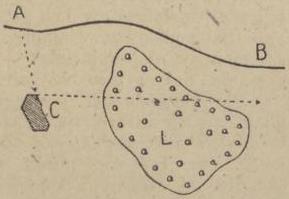
Fig. 21.
For example, the red team is ordered to occupy points M and L, capture any messenger heading toward B, and prevent or hinder the scouting patrol from breaking through in that direction.
The white troop advances along road A—B and has orders to avoid any enemy patrols encountered on the road. After leaving A, it sends scouts toward grove L and to point M. Upon receiving information that the red team is at M, it deviates from its original direction around point C to bypass the threatened area.
Meanwhile, from grove L (where the scouting patrol was sent), the patrol dispatches a messenger with a report in the direction of approximately C₁, assuming (based on the information they had) that the main troop is still advancing along road A—B. The messenger must break through the enemy line, and if successful, will not find the troop and must rack their brains to locate it and deliver the report. Behind them, the patrol breaks through either as a group or in a skirmish line, to later regroup at the designated assembly point.
Before the exercise, the conditions for any potential encounter with the enemy must be established.
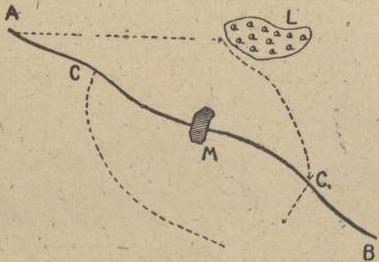
Fig. 22.
Scan source: Polona / National Library of Poland, marked “Public domain”. View scan — PDF pages 79–82.
Metadata
Section titled “Metadata”- Type: game
- Traits: Not stated in the source
- Source: Zygmunt Wyrobek, Harcerz w polu: zabawy i gry terenowe (1946)
- Printed pages: 73–76 / PDF 79–82
- Digital edition: Digital edition · Source record
- Open the edition at the relevant page: p. 73
- Read the source text: hwp-018