Following the Compass Rose
Translation details
Model:mistral-medium-2604.Translated text
Section titled “Translated text”Game marked with an asterisk in the book: more suitable for older scouts.
In partially wooded terrain, I place 5–10 small flags made of colored tissue paper. They stand upright from the ground, about a dozen centimeters tall. For each flag, I assign 1–2 scouts, and to each of them I provide the color of the flag they must find and its exact location on the map. Each scout “reads the map,” i.e., studies the route they must take to reach their flag without losing their way, and then sets off on the search.
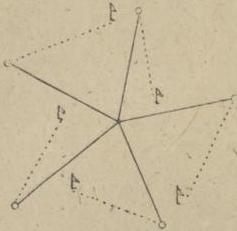
Fig. 20.
The distance may range from 500–1500 paces. Whoever finds their flag will also discover a small box next to it, containing a note with the bearing (azimuth) they must follow to the next objective and the distance to that objective (100–300 paces). The objective is a second flag of the same height and color as the first. Who (or which pair) will return with one flag, and who—this being the proper task—will bring back both? (Fig. 20).
For the game to succeed, the leader must first place the initial flags in locations that can be precisely marked on the map. Then, after setting each flag, they must proceed strictly along the given bearing line (i.e., at the specified azimuth) and place the second flag exactly at the given distance. These second flags should be equally visible to all.
If someone fails to find the second flag on their first attempt, they should return to the first flag and try again along the given bearing, rather than aimlessly searching around. Therefore, the first flag should not be taken until the second one is found.
Scan source: Polona / National Library of Poland, marked “Public Domain”. View scan — PDF pages 78–79.
Metadata
Section titled “Metadata”- Type: game
- Traits: Not stated in the source
- Source: Zygmunt Wyrobek, Harcerz w polu: zabawy i gry terenowe (1946)
- Printed pages: 72–73 / PDF 78–79
- Digital edition: Digital edition · Source record
- Open the edition at the relevant page: p. 72
- Read the source text: hwp-017