A Several-Day War
Translation details
Model:mistral-large-2512.Translated text
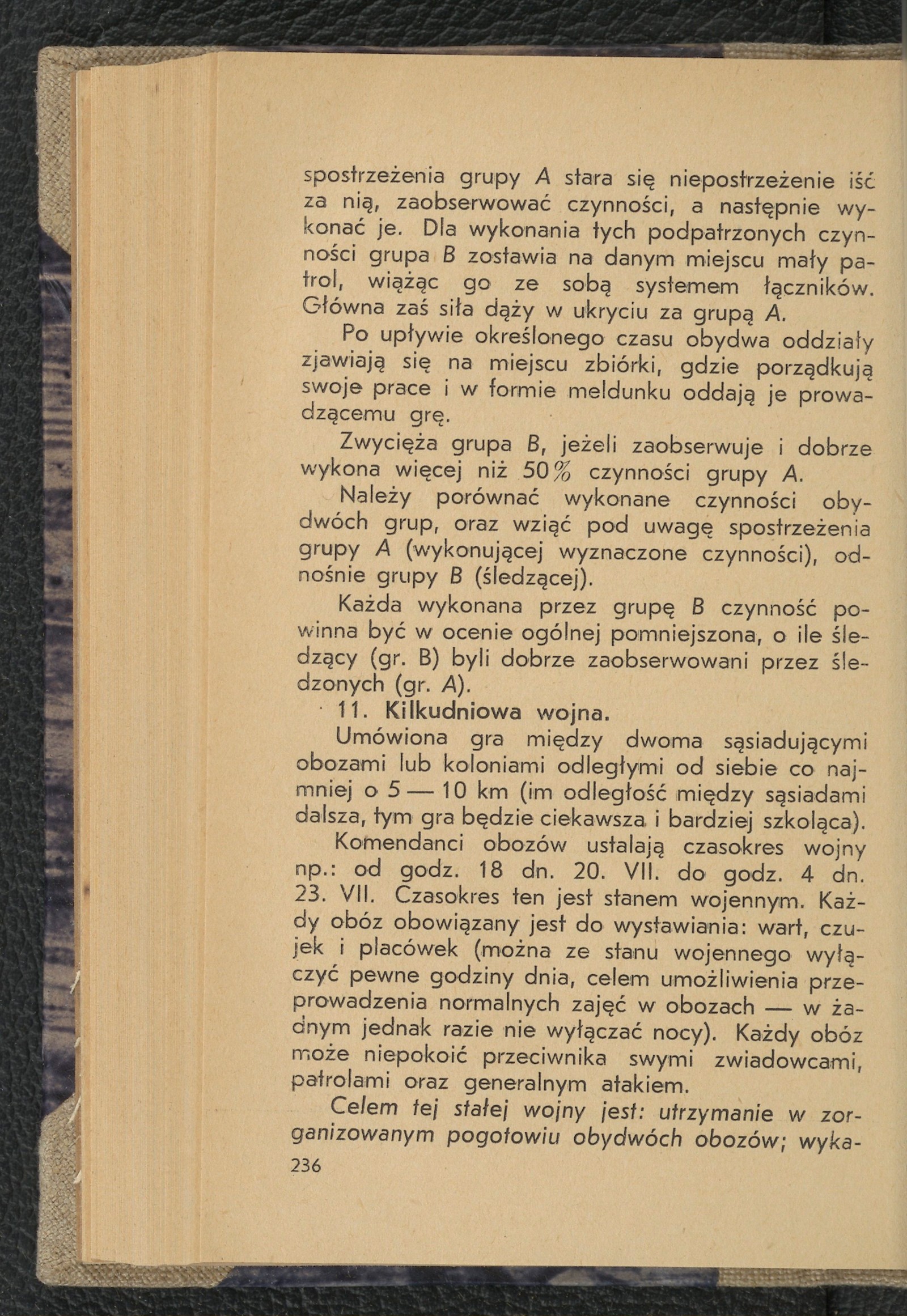
Section titled “Translated text”An agreed-upon game between two neighboring camps or colonies at least 5 — 10 km apart (the greater the distance between neighbors, the more interesting and instructive the game will be).
The camp commanders establish the timeframe of the war, e.g., from 18 on 20 July to 4 on 23 July. This timeframe constitutes a state of war. Each camp is obliged to maintain: guards, lookouts, and outposts (certain hours of the day may be excluded from the state of war to allow for normal camp activities—however, the night must never be excluded). Each camp may harass the enemy with its scouts, patrols, and a general attack.
The purpose of this continuous war is: to keep both camps in organized readiness; to demonstrate the tactical abilities of individual leaders; to train in night approaches, stealth, and patrolling; to test the psychological endurance and courage of individuals and the entire camp community.
Games of this type have a long tradition in many old scout troops (¹). These traditions date back to pre-independence times and are linked to the earnest, uncompromising preparation of youth for the struggle for freedom.
It is worthwhile to return to these old models of chivalrous combat, one of the most beautiful and valuable. It is worthwhile to revive such field games, so universal in training and testing the combat value of leaders and their troops. It is worthwhile to introduce these old field maneuvers into the work of our camps, leaving unforgettable, strong memories and indelible experiences in young hearts.
Below are the exemplary rules governing this game:
A) Valor lies on the side where there is more: calm, action in complete silence, unnoticed approach to the enemy, unexpected surprise, good humor (not malice) in playing tricks on the enemy. B) Under no circumstances should brawls be allowed. Only wrestling, without harm to clothes or bodies, may occur sporadically during the approach and neutralization of a guard (lookout).
¹) Based on wars of this type: 9:8 Warsaw Troop (Pomerania, 1921) and 14:17 Poznań Troop (Zakopane, 1923).
C) Both sides should be guided by the following principles: a) to see and hear as much as possible about the enemy camp’s actions and life; b) to carry out as many effective, harassing, and provocative actions against the enemy as possible; c) to prevent the enemy from gaining insight into the camp’s work and life, as well as any secret actions within one’s own camp.
D) Harassing and provocative actions against the enemy include the following activities: a) seeing and hearing as much as possible about the enemy camp’s actions and life; b) drawing pictures or writing on camp objects; c) hanging unnecessary and humorous items at various points in the camp; d) taking objects belonging to the camp or individuals, always leaving one’s own calling card to avoid misunderstandings; e) moving certain camp objects; f) toppling tents by loosening ropes or pulling them from pegs (cutting tent ropes is forbidden).
All the above and other actions are only successful if the enemy does not know when they were carried out or by whom. Any open attacks with superior forces are contrary to the spirit of this game.
Excluded from this game are the removal of the national flag from the mast and the taking of the troop’s banner.
Only a struggle for a signaling pennant, bearing special markings and placed in an agreed-upon location, may be introduced.
To carry out the above actions and gain an advantage in them, camp commanders must organize the security of their camp and frequently reconnoiter the enemy camp using scout patrols.
Security must cover not only the camp itself but also the approaches to it—through outposts, lookouts, and patrols sent further into the field.
Frequent encounters between enemy patrols will occur. In such cases, they should disperse. The goal will always be good observation of the enemy’s actions and concealment of one’s own activities.
The main time for action will be at night, following prior reconnaissance of the terrain during the day. During the night, the known rules of action apply, as stated on page 287, with silence and surprise being paramount.
The basis of all nighttime action will be diverting attention from certain points and directing the enemy’s actions into a prepared ambush.
Throughout this war, communication must not be forgotten: foot messengers, optical signals, and reports.
Success will depend on its good organization.
After the designated war period expires, a summary of actions and observations is made, and trophies are tallied at a joint staff meeting. After settling these matters, each leader discusses the entire operation within their group.
It is important to remember, both during the game and after its conclusion, to extend the morning sleep of the boys and allow them freedom to sleep during the day.
Source of scan: Polona / National Library, marked “Public Domain”. View scan — page 244.
Metadata
Section titled “Metadata”- Type: game
- Traits: Not stated in the source
- Source: Jan Jasiński, Gry i ćwiczenia terenowe (Harce terenowe) (1938)
- Printed pages: 236–239
- Digital edition: Digital edition · Source record
- Open the edition at the relevant page: p. 236
- Read the source text: gct-196