Breaking Through a Route Blocked by the Enemy
Translation details
Model:mistral-large-2512.Translated text
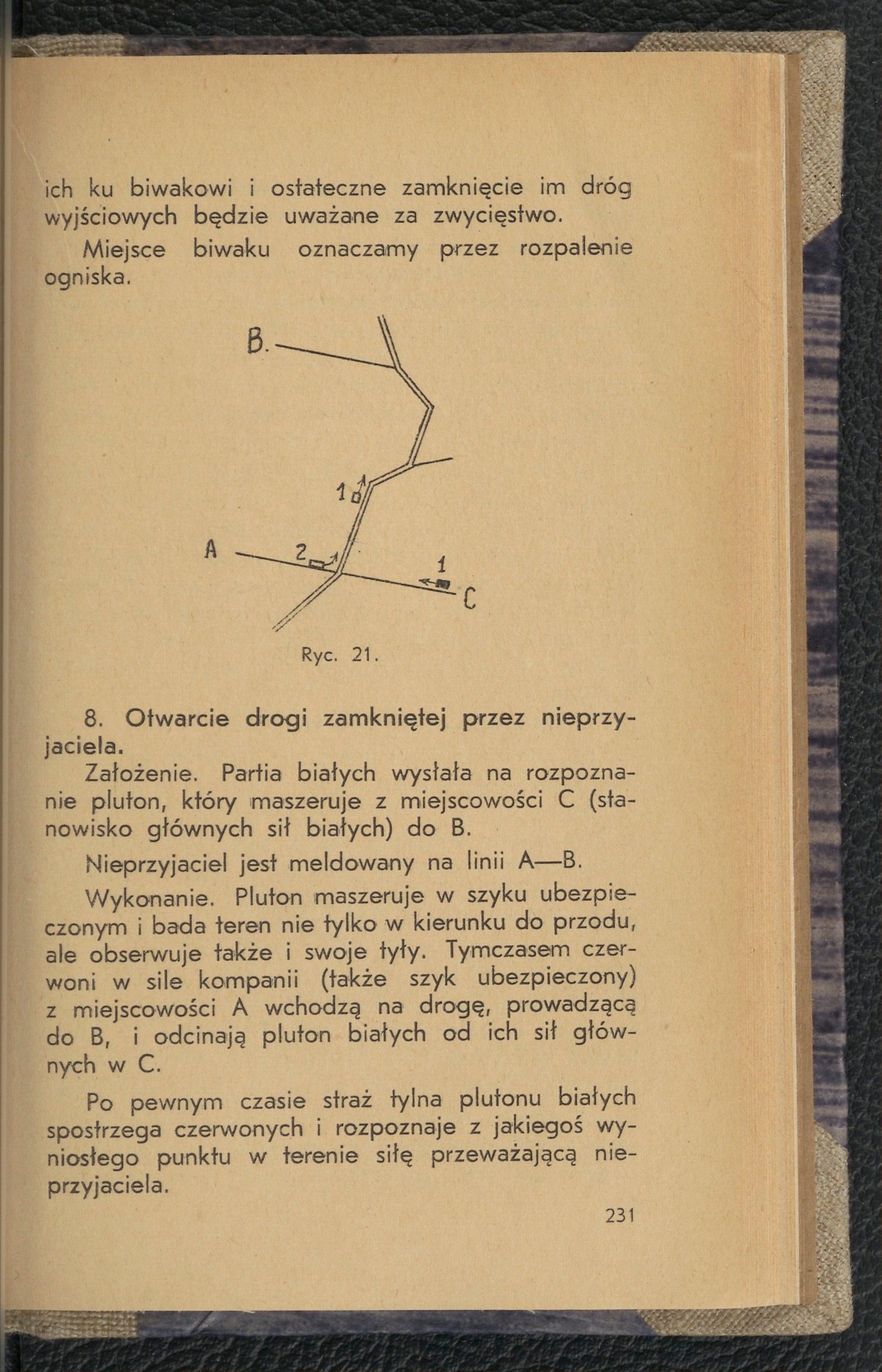
Section titled “Translated text”Assumption. The White party has dispatched a reconnaissance platoon marching from locality C (position of the White main forces) to B.
The enemy is reported along the line A—B.
Execution. The platoon marches in a secured formation and surveys the terrain not only ahead but also observes its rear. Meanwhile, the Reds, in company strength (also in a secured formation), emerge from locality A onto the road leading to B and cut off the White platoon from their main forces in C.
After some time, the White platoon’s rear guard spots the Reds and, from an elevated point in the terrain, assesses the enemy’s superior strength.
The White platoon commander, upon seeing this situation, acts as follows: a) Dispatches messengers to locality C with reports about the enemy cutting them off. These messengers face the difficult task of crossing terrain occupied by the enemy’s march. They carry two messages: one factual regarding the platoon’s intentions, the other deceptive. The first is to be destroyed if the messenger is captured by the enemy, while the second should be found by them.
b) Prepares an ambush at a suitable point further along the route. The first ambush, consisting of a 5-th or 6-th part of the platoon, is ordered to let the enemy’s main forces pass before striking their rear units. If combat ensues, they are to withdraw into the woods. The remaining detachment prepares the main ambush half a kilometer further, striking the main forces of the enemy company after some time.
Possible outcomes may vary: a) The platoon’s plan succeeds. The first ambush, undetected, strikes the rear; combat ensues, drawing part of the enemy company’s main forces. The ambush then withdraws to the side, pulling a significant portion of the pursuing forces with them. The weakened company is then attacked by the platoon’s main ambush. b) The platoon’s plan partially succeeds. The first ambush, spotted by the enemy’s advance guard, is attacked and forced to withdraw to the side. After a brief halt and sending reinforcements for pursuit, the company continues marching and falls into the second ambush. c) The platoon’s plan fails. The first ambush is neutralized or pushed aside, failing to create confusion or divert part of the Red company. The second ambush is also discovered and repelled toward B.
In the first two cases, the White platoon prevails; in the third, the Red company wins.
Other possible outcomes include: a) A strike by the main forces from C against the company, thanks to messages delivered by the messengers. b) The Red company earlier detects the White platoon, flanks it with a detachment to outmaneuver and strike from two sides. c) The Red company, having identified the enemy ahead and behind, attacks the White platoon.
The course and resolution may vary, but they will always rely on patrolling, maintaining communication, map-based orientation, and the tactical acumen of the leaders of individual groups. The exercise may be left to unfold naturally (at a higher level) or dictated in specific resolutions, at least for one group (at a lower level). These are not difficult exercises, as they might seem. They require only greater experience from the leaders of individual detachments. Such exercises can easily be conducted by teachers or instructors who are reserve officers.
Source scan: Polona / National Library, marked “Public Domain.” View scan — image 239.
Metadata
Section titled “Metadata”- Type: game
- Traits: Not stated in the source
- Source: Jan Jasiński, Gry i ćwiczenia terenowe (Harce terenowe) (1938)
- Printed pages: 231–233
- Digital edition: Digital edition · Source record
- Open the edition at the relevant page: p. 231
- Read the source text: gct-193