Occupying Positions
Translation details
Model:mistral-large-2512.Translated text
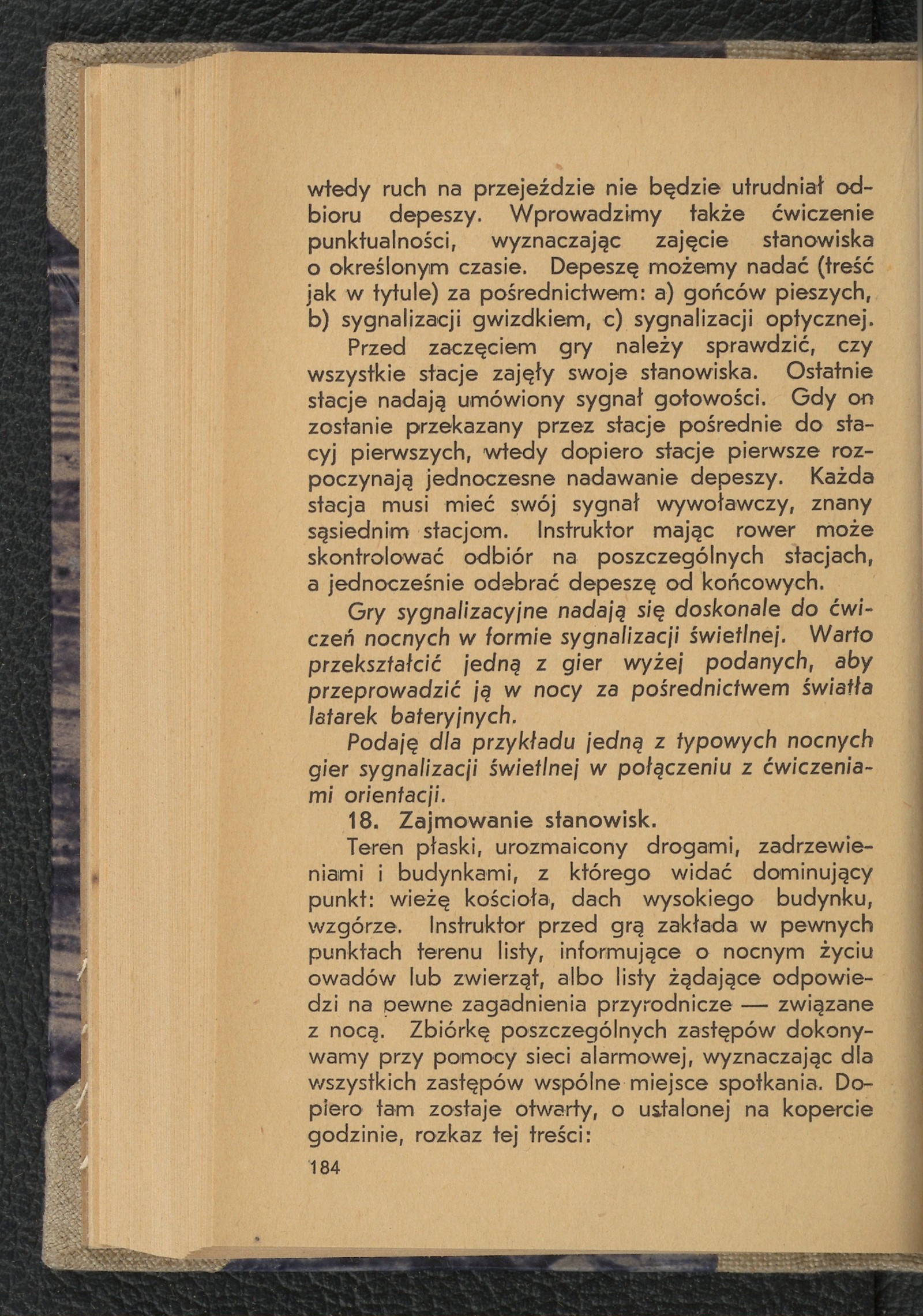
Section titled “Translated text”Flat terrain, varied with roads, woodlands, and buildings, from which a dominant point is visible: a church tower, the roof of a tall building, a hill. Before the game, the instructor places lists at certain points in the area, informing about the nocturnal life of insects or animals, or lists requiring answers to certain natural history questions—related to the night. The assembly of individual patrols is carried out using an alarm network, designating a common meeting place for all patrols. Only there, at the hour specified on the envelope, is the following order opened:
“Find the light signaling station located in the N.W. direction.
Each patrol will receive individual orders from the station, designating its appropriate positions. March in a secure formation.
After occupying the designated position, find and copy the hidden lists there. The station will begin transmitting new orders at the hour 22.30 and the next at the hour 23.15. Execute them strictly. Patrols read and note all dispatches but carry out only the dispatch intended for them.
A dispatch for a given patrol begins with the name of the patrol’s emblem.
The patrol that flawlessly reads all transmitted dispatches, executes the orders issued for it within the prescribed time, finds all the lists, and is not late to the final assembly point wins.
Be Prepared!
Maned Horse, Troop Leader.
Janowa Dolina, the 20 of July, at 19 o’clock.”
The Troop Leader transmits dispatches personally or with the help of assistants, having prepared the entire route of the patrols and the content of the dispatches. Dispatches should be as short as possible but clear. They are transmitted only once, and therefore this game can only be conducted with patrols for whom light signaling is not a novelty. This game should be conducted in terrain familiar to the youth. There should be twice as many points with lists as there are patrols. Patrols should not meet at the points where lists are hidden. Before the game, it should be checked whether the signaling station will be visible from each point. The time for transmitting the next dispatch must be calculated according to the path of the patrol that receives instructions last, plus 15 minutes reserve for unforeseen circumstances. The last dispatch provides a common meeting place for all. There, the Troop Leader receives reports and evaluates the results of the games. This game can be expanded and made more difficult by crossing the patrol routes and introducing competition between patrols, according to the principle: “See and hear without being seen or heard.”
Source of scan: Polona / National Library, marked “Public Domain”. View scan — page 192.
Metadata
Section titled “Metadata”- Type: game
- Traits: Not stated in the source
- Source: Jan Jasiński, Gry i ćwiczenia terenowe (Harce terenowe) (1938)
- Printed pages: 184–186
- Digital edition: Digital edition · Source record
- Open the edition at the relevant page: p. 184
- Read the source text: gct-115