Elephant Hunters
Translation details
Model:mistral-large-2512.Translated text
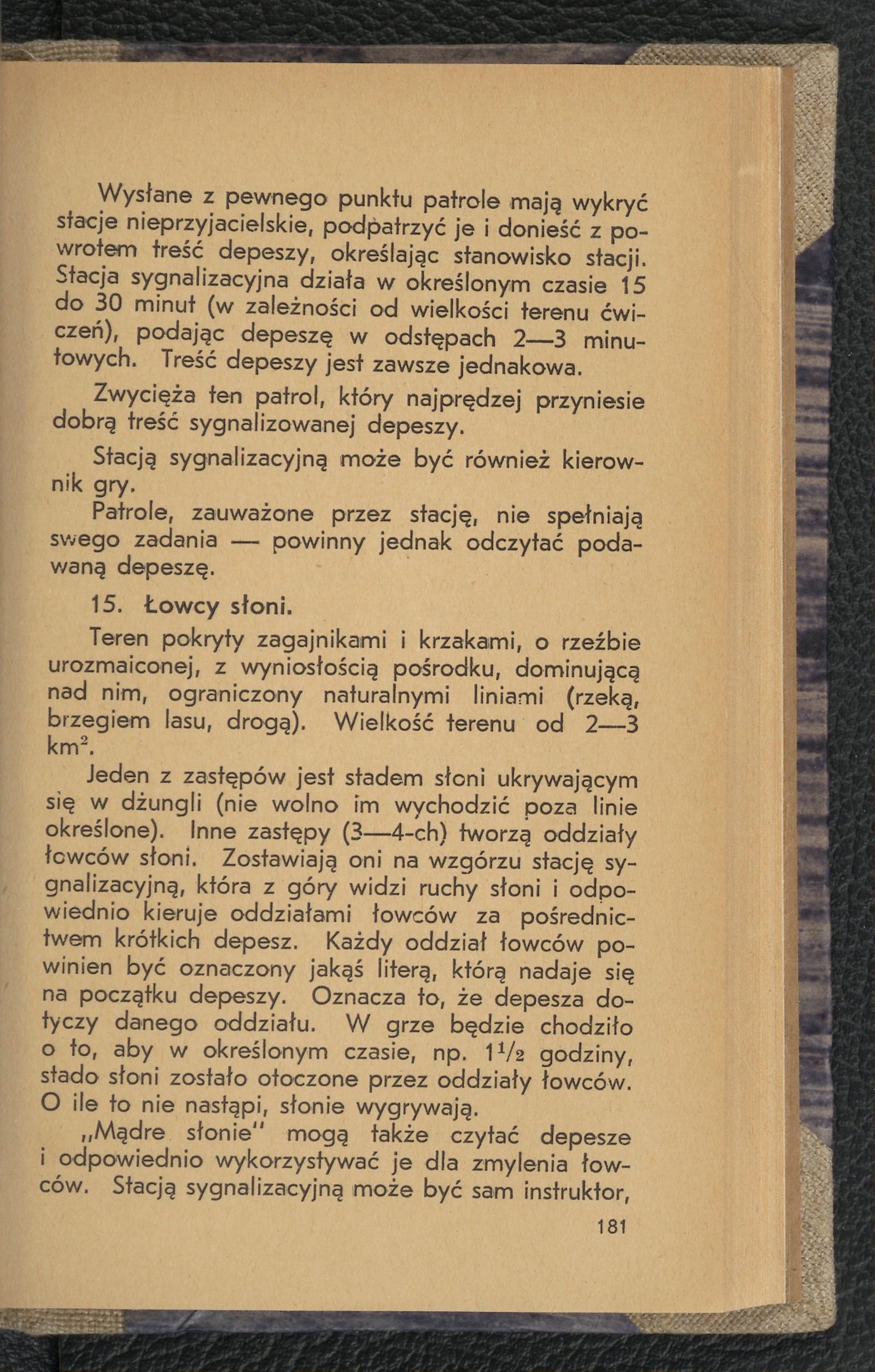
Section titled “Translated text”Terrain covered with thickets and bushes, with varied topography, featuring a height in the center dominating the area, bounded by natural lines (a river, forest edge, road). The size of the terrain ranges from 2—3 kilometers to ².
One of the patrols is a herd of elephants hiding in the jungle (they must not cross the defined boundaries). The other patrols (3—4 in number) form elephant-hunting parties. They establish a signaling station on the hill, which overlooks the elephants’ movements and directs the hunting parties accordingly via short dispatches. Each hunting party should be marked with a letter, which is placed at the beginning of a dispatch. This indicates that the dispatch concerns that particular party. The objective of the game is to surround the elephant herd with the hunting parties within a set time, for example, 1½ hours. If this does not occur, the elephants win.
The “wise elephants” may also read the dispatches and use them to mislead the hunters. The signaling station may be operated by the instructor, who should, in any case, remain near the station to regulate the game’s progress. The initial positioning of the hunting parties and the elephant herd can be determined using a map or signaling dispatches.
We must not forget auditory signaling. It has fully permeated everyday life today and will dominate future warfare. Every well-organized unit beginning training in auditory signaling should procure an old buzzer telephone or construct a telegraph key independently. In the worst case, a system of tapping on resonant objects or using a whistle can be employed. Familiarity with the Morse alphabet, on which auditory training will be based, will facilitate conducting these games.
In the Morse method, we phonetically distinguish two sounds: a) short — tit (dot) — lasts half a second. b) long — taa (dash) — lasts 1 raised to the power of 1/2 seconds.
Pauses between individual sounds should not exceed half a second; between letters, 1¹/₂ seconds; between words, 2¹/₂ seconds (6 tit sounds).
In gradual training, we can apply the entire system of preliminary games designed for visual signaling, slightly modifying them. A whistle or a strong buzzer will be used to produce sounds. Additionally, the following games will be conducted:
Source scan: Polona / National Library, marked “Public Domain”. View scan — page 189.
Metadata
Section titled “Metadata”- Type: game
- Traits: Not stated in the source
- Source: Jan Jasiński, Gry i ćwiczenia terenowe (Harce terenowe) (1938)
- Printed pages: 181–182
- Digital edition: Digital edition · Source record
- Open the edition at the relevant page: p. 181
- Read the source text: gct-112