Elimination
Translation details
Model:mistral-large-2512.Translated text
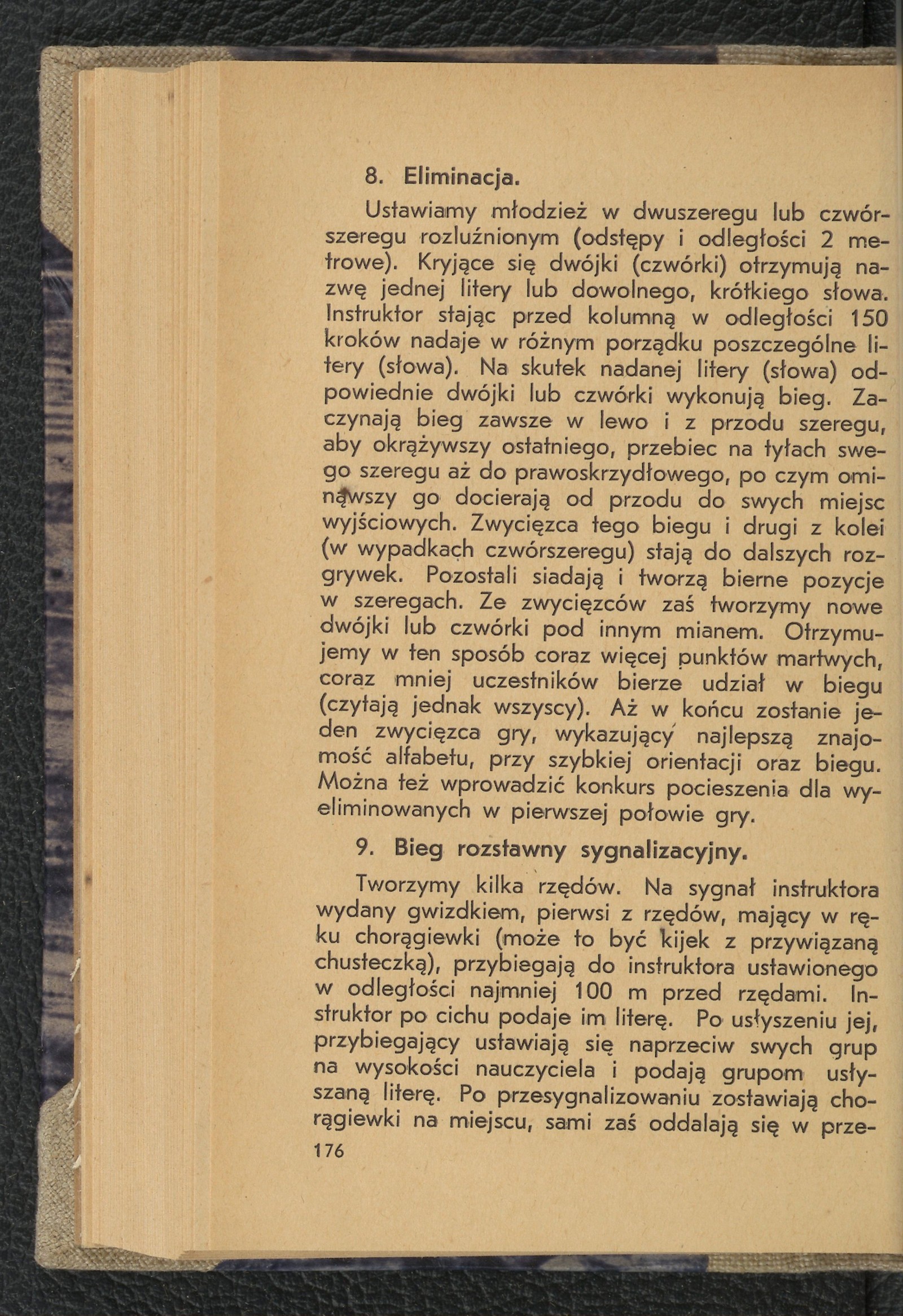
Section titled “Translated text”We arrange the youth in a relaxed double rank or quadruple rank (intervals and distances of 2 metres). The covering pairs (or fours) are assigned the name of a single letter or any short word. The instructor, standing in front of the column at a distance of 150 paces, calls out individual letters (or words) in varying order. Upon hearing their assigned letter (or word), the corresponding pairs or fours begin a run. They always start the run to the left and from the front of the rank, circle around the last person, sprint along the rear of their rank until they reach the right-flank member, then pass them and return from the front to their original positions. The winner of this run and the second-place finisher (in the case of a quadruple rank) proceed to further rounds. The rest sit down and form passive positions in the ranks. From the winners, we form new pairs or fours under a different name. In this way, we create more and more ‘dead points,’ and fewer participants take part in the run (though all continue to listen). Eventually, one winner remains—the one demonstrating the best knowledge of the alphabet, quick orientation, and speed. A consolation competition may also be introduced for those eliminated in the first half of the game.
Source scan: Polona / National Library, marked “Public Domain.” View scan — image 184.
Metadata
Section titled “Metadata”- Type: game
- Traits: Not stated in the source
- Source: Jan Jasiński, Gry i ćwiczenia terenowe (Harce terenowe) (1938)
- Printed pages: 176
- Digital edition: Digital edition · Source record
- Open the edition at the relevant page: p. 176
- Read the source text: gct-105