Messenger Service
Translation details
Model:mistral-large-2512.Translated text
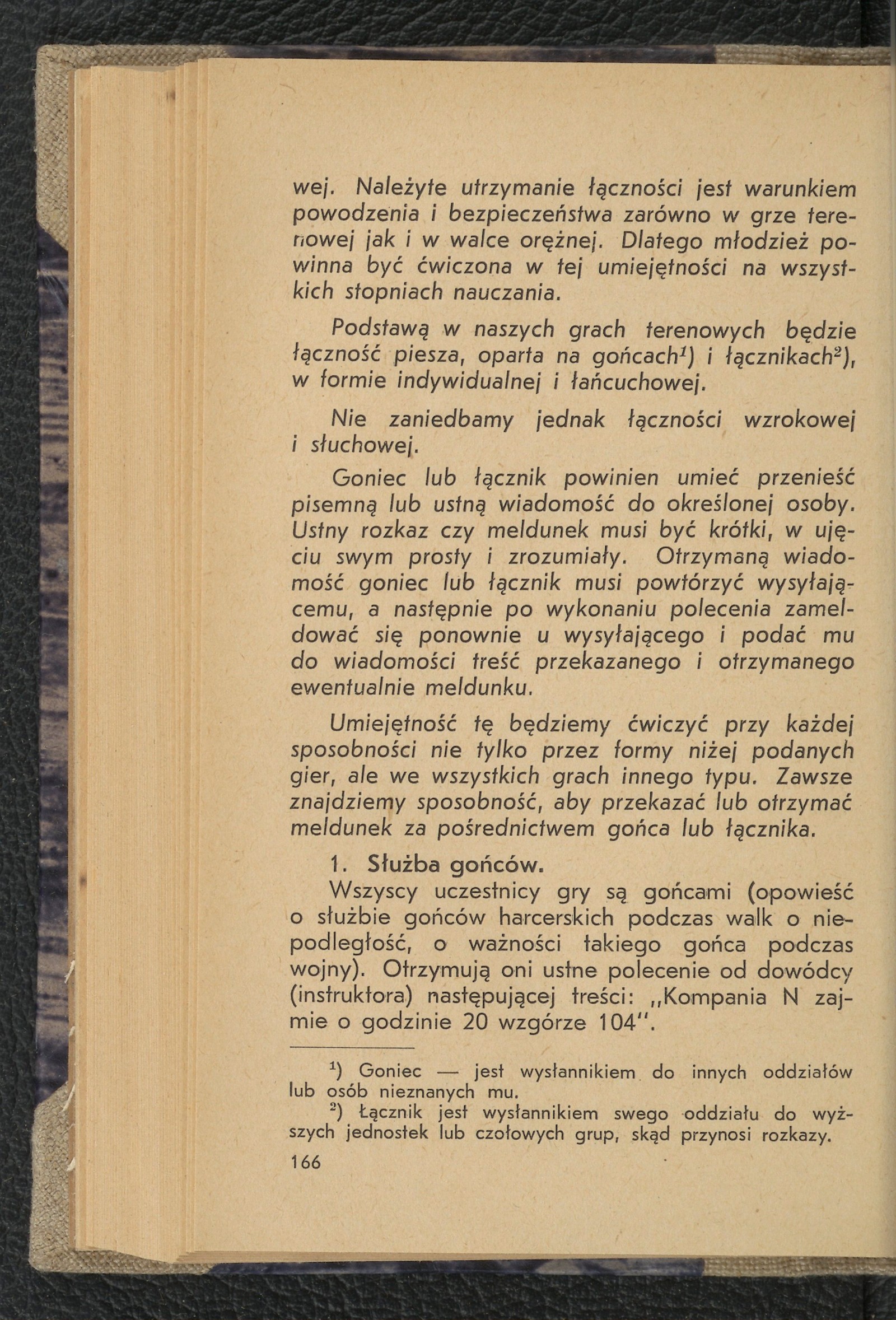
Section titled “Translated text”All participants in the game serve as messengers (a tale of the scouting messenger service during the struggle for independence, and the importance of such a messenger during war). They receive a verbal command from the commander (instructor) as follows: “Company N will occupy hill 104 at 20 o’clock.”
¹) A messenger is an envoy sent to other units or unknown individuals.
²) A liaison is an envoy from their unit to higher formations or leading groups, from which they bring back orders.
Messengers, standing at attention, repeat the received order, then at a signal, they run (part of the way they sprint, part they march, part they crawl—depending on the terrain cover) a distance of 100—200 meters to a point specified by the instructor (the location of Company N’s commander). Upon reaching the designated spot, they return, line up at a distance of 15 paces from one another, and repeat or write down the content of the received order. If writing on slips of paper, they do so at the last moment. The best messengers are those who have not forgotten the command.
A. We can make the game more challenging by adding a report received from Company N’s commander (the instructor moves to the designated spot and provides new content, e.g.: “An enemy force the size of a company is outflanking us from the east”).
B. It is also possible to use the delivery of written orders to a person who must be located at a specific point on the terrain. Messengers must find this point and locate the individual.
C. We create from 2 to 5 chains (relays) of messengers. We position them along a road or, preferably, directly in a field or forest.
The task of each chain will be to verbally transmit any order, with content common to all.
Messenger chains can be spaced even over a distance of 1 kilometers, depending on the number of participants. For ease, they can be arranged in an arc. Then, the instructor, without moving from their position, can easily become the recipient of the transmitted order. Message transmission can also be done by running. However, the run must not exceed the established norms: for those under 12 years of age—40 meters, under 16—60 meters, under 18—100 meters. Longer and more sustained runs may be used for youth over 17 years of age.
The aim of this game is not speed but, above all, the accuracy of the verbal order’s transmission.
In the case of written message delivery, the time of arrival determines the outcome (limit the running distance to the capabilities of the participants’ age).
D. We can effectively practice the liaison chain during a march on a road. We distribute pairs along our marching route, walking side by side on both sides of the road at intervals of 20—60 meters. This distance will depend on the time of day, terrain cover, and road bends.
Each liaison sees their predecessor, and in more difficult spots, such as road forks, they indicate the correct direction to the next. One side of the liaisons (e.g., the left) is the line transmitting orders forward, while the other (the right) is the line along which reports are sent backward.
Orders and factual reports, such as those about one’s own position, the terrain, and events occurring on it, should be fairly frequent.
The above exercises can also be conducted in winter, on skis.
If bicycles are available, they can be used as a variable means of locomotion for one liaison chain or as a fast-moving tool for individual messengers. In this case, all liaisons should be able to ride a bicycle. On water, we can use kayaks or boats as means of communication, or even employ swimming.
Source scan: Polona / National Library, marked “Public Domain.” View scan — page 174.
Metadata
Section titled “Metadata”- Type: game
- Traits: Not stated in the source
- Source: Jan Jasiński, Gry i ćwiczenia terenowe (Harce terenowe) (1938)
- Printed pages: 166–168
- Digital edition: Digital edition · Source record
- Open the edition at the relevant page: p. 166
- Read the source text: gct-098