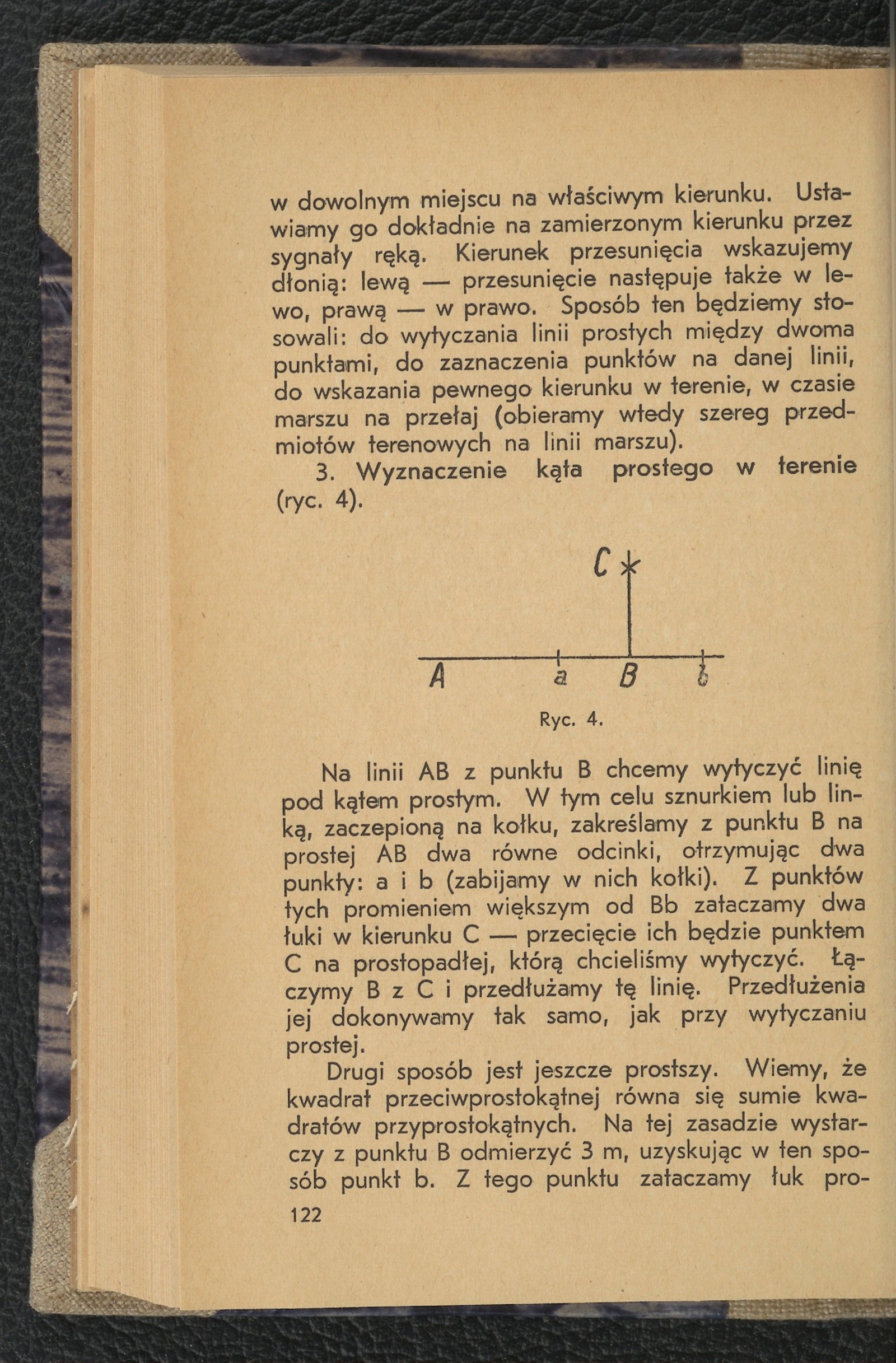
Establishing a Right Angle in the Field (Fig.
Translation details
Model:mistral-large-2512.Translated text
Section titled “Translated text”4).
Fig. 4.
On line AB, from point B, we wish to lay out a line at a right angle. To do this, using a string or cord tied to a peg, we mark two equal segments from point B along the straight line AB, obtaining two points: a and b (we drive pegs into these). From these points, with a radius greater than Bb, we draw two arcs in the direction of C—their intersection will be point C on the perpendicular we wished to lay out. We connect B with C and extend this line. The extension is done in the same way as when laying out a straight line.
A second method is even simpler. We know that the square of the hypotenuse equals the sum of the squares of the legs. Based on this principle, it suffices to measure 3 metres from point B, thus obtaining point b. From this point, we draw an arc with a radius of 5 metres in the direction of the presumed perpendicular, and from point B, in the same direction, an arc with a radius of 4 metres. The intersection of these arcs will give us point C, through which the desired perpendicular will pass. The principle: 4² plus 3² equals 5².
If we possess a Bézard compass, establishing a right angle in the field will be quicker and easier.
4 Measuring height, e.g., of a tree, chimney (Fig. 5), house, or hill. a) According to the ratio of shadow and actual height of the object, based on the formula:
Fig. 5.
$$\frac{\text{shadow of the rod (a)}}{\text{shadow of the tree (b)}} = \frac{\text{height of the rod (c)}}{\text{height of the tree (x)}}$$
We can measure the shadow of the tree and the shadow of the rod, as well as the height of the rod. Knowing these three dimensions, we can find the fourth, sought-after one, based on the transformed formula: $$x = \frac{b \cdot c}{a}$$.
This formula can be applied at any time of a sunny day or a moonlit night.
b) In case the sun is not visible, we can measure height based on the principle of similar triangles (Fig. 6).
Fig. 6.
To measure height, in this case of a chimney, one participant must lie down and look along the end of a rod (preferably 1 or 2 metres in length), positioned between themselves and the base of the chimney. They adjust the rod with the help of another participant so that their eyes, the end of the rod, and the top of the chimney lie on a single line. Then, based on the similarity of triangles ABC and EDC, we can find the desired height (point C is the position of the lying pupil’s eyes) thanks to the proportionality of the sides $$\frac{BC}{DC} = \frac{AB}{ED}$$, from which $$AB = \frac{BC \times ED}{DC}$$.
Practically, we must determine how many times segment DC is smaller than segment BC, and then, having multiplied the height of the rod by this ratio, we obtain the sought height of the object.
Source of scan: Polona / National Library, marked “Public Domain”. View scan — page 130.
Metadata
Section titled “Metadata”- Type: game
- Traits: Not stated in the source
- Source: Jan Jasiński, Gry i ćwiczenia terenowe (Harce terenowe) (1938)
- Printed pages: 122–124
- Digital edition: Digital edition · Source record
- Open the edition at the relevant page: p. 122
- Read the source text: gct-061