Measuring Width
Translation details
Model:mistral-large-2512.Translated text
Section titled “Translated text”This may be the width of a river, pond, lake, marsh, ravine, sown field, etc.
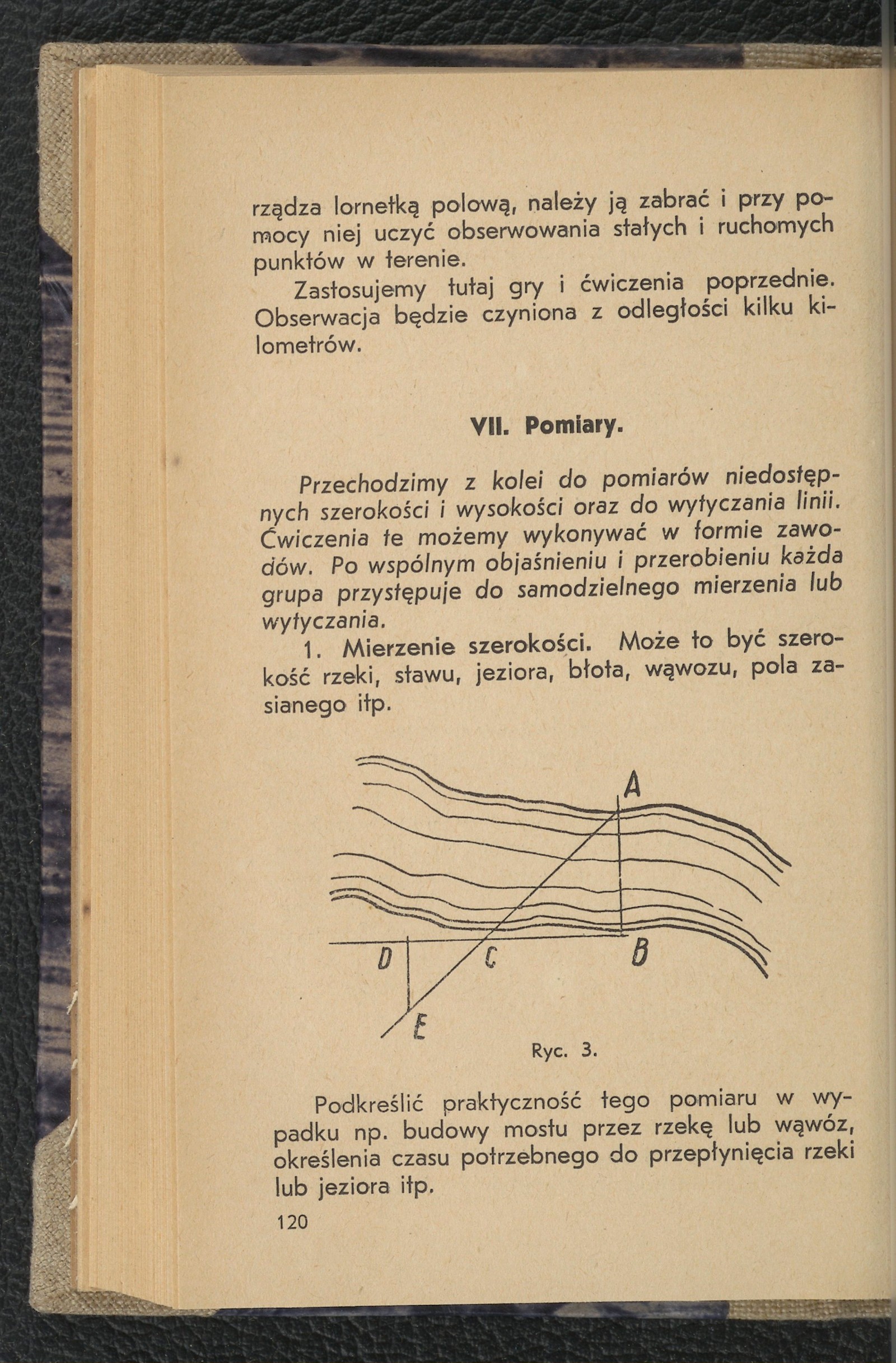
Fig. 3.
Emphasize the practicality of this measurement in cases such as building a bridge across a river or ravine, determining the time needed to swim across a river or lake, etc.
We choose an arbitrary point A in the form of a bush or stone on the opposite bank and point B on our own bank, where we plant a stick or position one of the boys (Fig. 3). Next, we draw a perpendicular to the line thus obtained in space on our bank, at an arbitrary point (C) where we position a second boy. We extend the line BC and, depending on the terrain, measure from point C the full length of segment BC or a part of it (1/2, 1/3, 1/4). At the point D thus obtained, we position another boy and at this same point, we mark a line perpendicular to line BD, running along the bank. We move along this perpendicular with our eyes fixed on point C until the latter covers point A on the opposite bank. We then obtain point E, and having measured line DE, we can, based on the proportionality of triangles ABC and CDE and the known lengths of segments BC, DC, and DE, find the width AB using the formula $$ \frac{AB}{DE} = \frac{BC}{CD} $$, from which $$ AB = \frac{DE \times BC}{CD} $$.
Practically, for the youngest, it is sufficient to state without proof that if segment CD was equal to CB, then segment DE will also be equal to AB. In the case where CD is a part (1/4, 1/3, 1/2) of segment CB, then segment DE will be that many times smaller than AB. It is therefore enough to multiply the number of steps of segment DE by 4, 3, or 2 to find the inaccessible width, i.e., AB.
Source of scan: Polona / National Library, marked “Public Domain”. View scan — image 128.
Metadata
Section titled “Metadata”- Type: game
- Traits: Not stated in the source
- Source: Jan Jasiński, Gry i ćwiczenia terenowe (Harce terenowe) (1938)
- Printed pages: 120–121
- Digital edition: Digital edition · Source record
- Open the edition at the relevant page: p. 120
- Read the source text: gct-059