Observing the Enemy
Translation details
Model:mistral-large-2512.Translated text
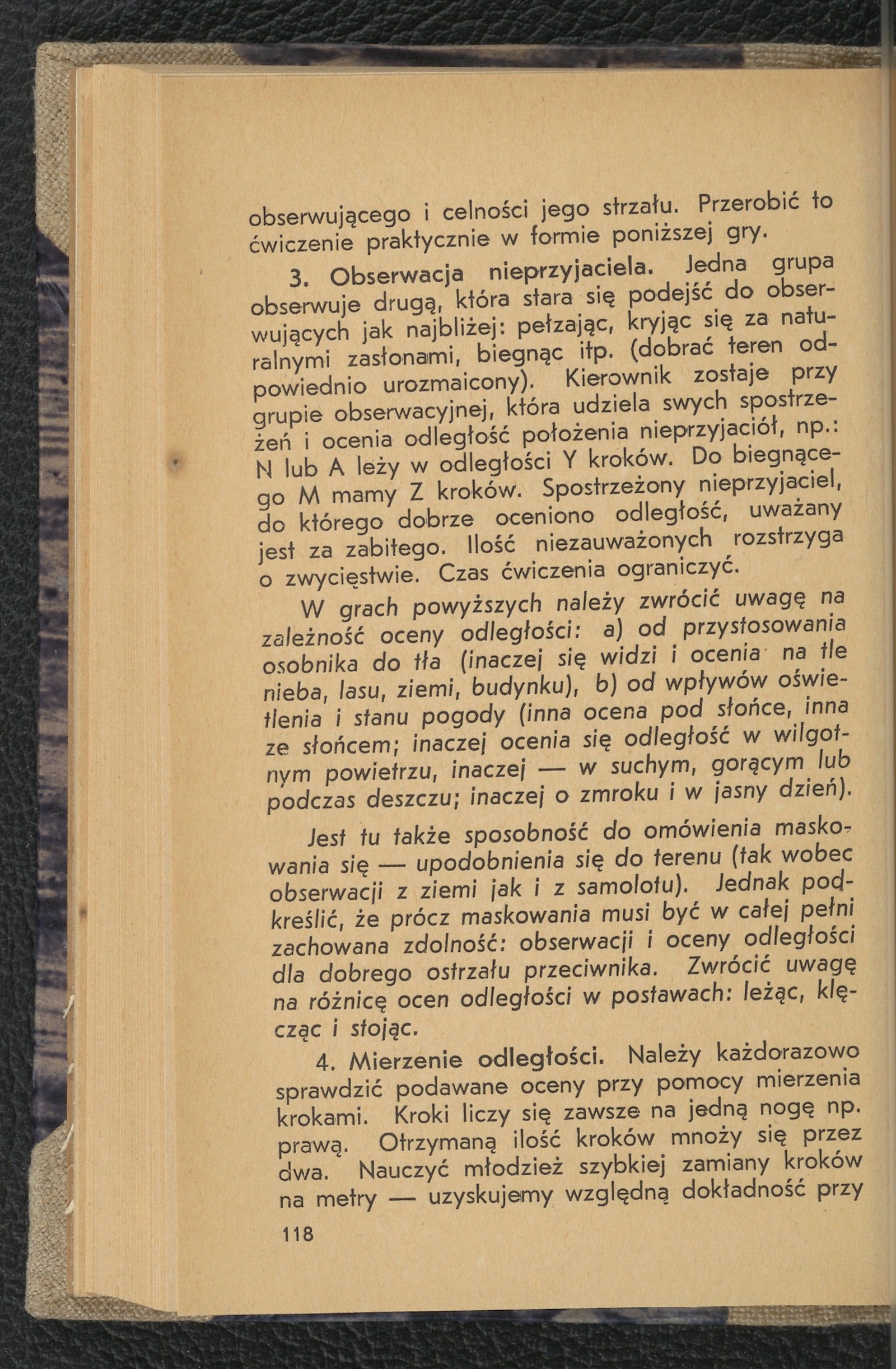
Section titled “Translated text”One group observes another, which attempts to approach the observers as closely as possible: crawling, concealing itself behind natural cover, running, etc. (choose appropriately varied terrain). The leader stays with the observation group, which shares its observations and estimates the distance of the enemy’s position, e.g.: N or A lies at a distance of Y paces. To the running M, we have Z paces. An observed enemy whose distance is accurately estimated is considered eliminated. The number of undetected enemies determines victory. Limit the duration of the exercise.
In the above games, attention should be paid to the factors affecting distance estimation: a) the individual’s adaptation to the background (visibility and assessment differ against the sky, forest, ground, or a building), b) the influence of lighting and weather conditions (assessment differs when facing the sun versus having the sun behind; distance is judged differently in humid air, dry and hot air, or during rain; differently at dusk and in broad daylight).
This also provides an opportunity to discuss camouflage—blending into the terrain (both for ground observation and from aircraft). However, it must be emphasized that, in addition to camouflage, the full ability to observe and estimate distances for effective enemy fire must be maintained. Note the differences in distance estimation when lying down, kneeling, and standing.
Source scan: Polona / National Library, marked “Public Domain”. View scan — image 126.
Metadata
Section titled “Metadata”- Type: game
- Traits: Not stated in the source
- Source: Jan Jasiński, Gry i ćwiczenia terenowe (Harce terenowe) (1938)
- Printed pages: 118
- Digital edition: Digital edition · Source record
- Open the edition at the relevant page: p. 118
- Read the source text: gct-054