Nature Kim's Game
Translation details
Model:mistral-large-2512.Translated text
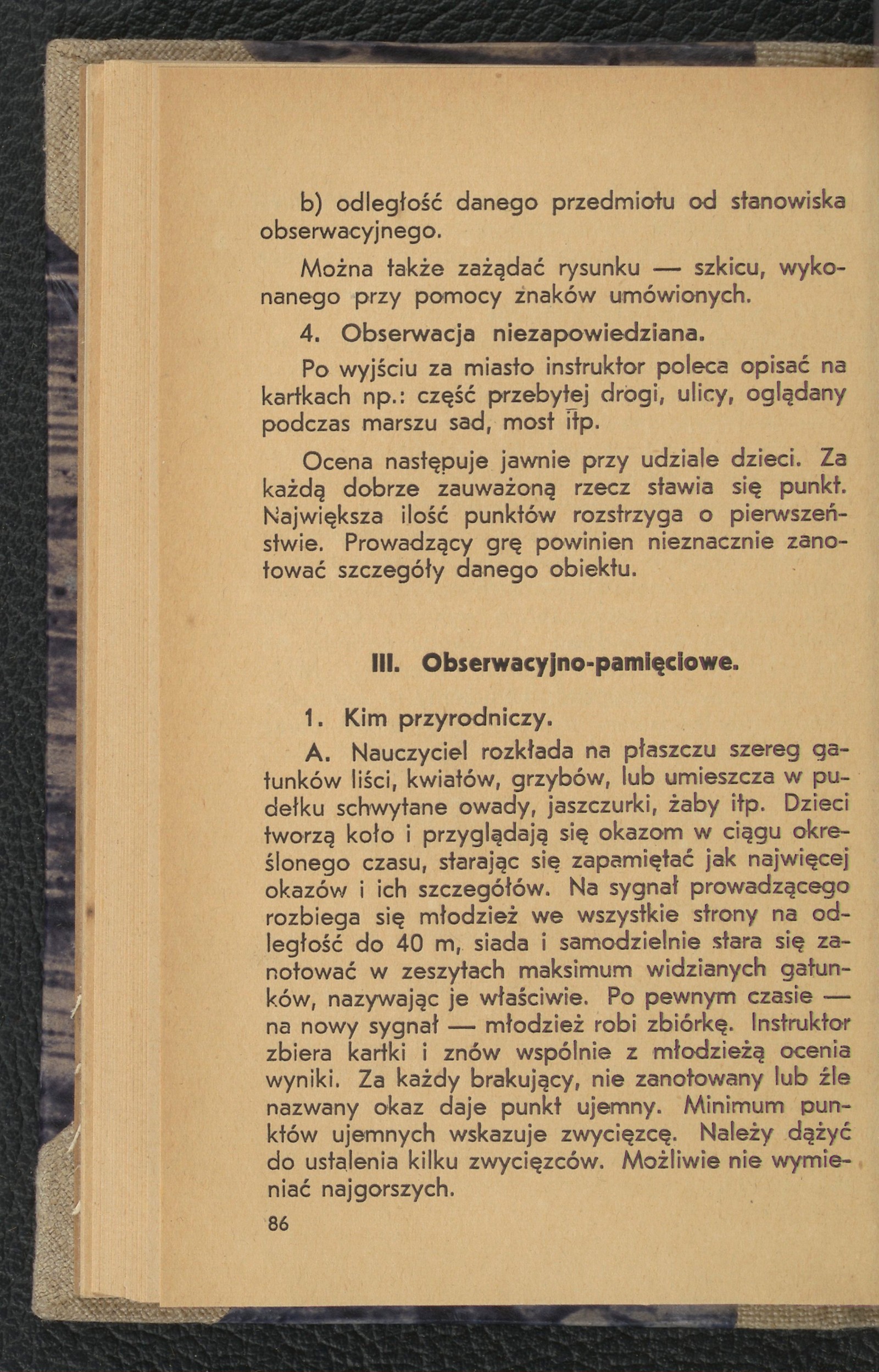
Section titled “Translated text”A. The instructor lays out on a cloak a series of species of leaves, flowers, fungi, or places in a box captured insects, lizards, frogs, etc. The children form a circle and observe the specimens for a set period, striving to memorize as many specimens and their details as possible. On the leader’s signal, the youth scatter in all directions up to 40 metres, sit down, and independently attempt to note in their notebooks the maximum number of observed species, naming them correctly. After some time—on a new signal—the youth regroup. The instructor collects the sheets and, together with the youth, evaluates the results. For each missing, unrecorded, or incorrectly named specimen, a negative point is given. The minimum number of negative points indicates the winner. It is advisable to establish several winners. Avoid naming the poorest performers if possible.
The game can be made more challenging by: a) reducing the observation time, b) reducing the recording time, c) increasing the number of specimens, d) diversifying their species, e) adapting them to the background on which they lie, f) reducing their size.
Emphasis should be placed on independence in the game and recording. If “cheating” is noticed, the individual in question should be excluded from the game.
B. A more advanced form of this game will involve bringing the observed species from the terrain (plants or insects must be found in the immediate vicinity). The end time for searching should be announced with a whistle or trumpet.
C. The Nature Kim’s Game can be varied by crawling, requiring silent approach to the laid-out specimens, similar to a hunter stalking game. Here, groups (troops or patrols) can compete in turn, collaboratively preparing a report on the observed specimens.
D. A further challenge will be sentries, whom we position in easier-to-approach terrain at the corners of a square 20 by 20 or 10 by 10 paces. In the centre of this square, we place a series of natural specimens or other objects. The sentries have their eyes blindfolded and attempt to detect the direction of the stalkers by sound. The instructor observes those approaching and excludes from the game anyone who stalks poorly, as well as those correctly identified by the sentries. The winner is the one who, undetected by the sentries, reports the greatest number of correctly observed objects. This is already a listening game, a stalking game, and simultaneously an observational-memory game.
Source scan: Polona / National Library, marked “Public Domain”. View scan — page 94.
Metadata
Section titled “Metadata”- Type: game
- Traits: Not stated in the source
- Source: Jan Jasiński, Gry i ćwiczenia terenowe (Harce terenowe) (1938)
- Printed pages: 86–87
- Digital edition: Digital edition · Source record
- Open the edition at the relevant page: p. 86
- Read the source text: gct-010