Redeeming Forfeits
Translation details
Model:mistral-large-2512.Translated text
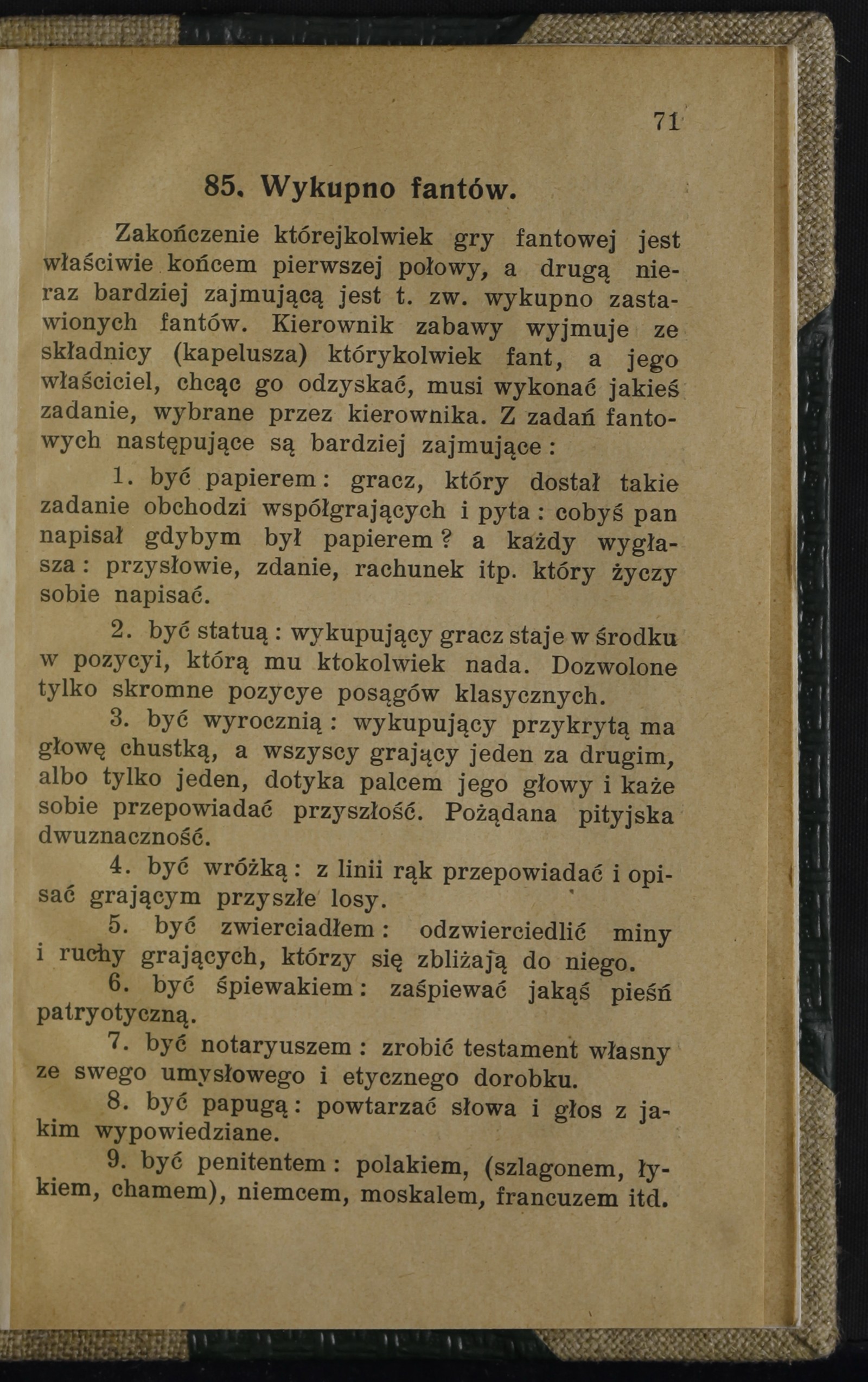
Section titled “Translated text”The conclusion of any forfeit game is essentially the end of the first half, while the second, often more engaging part, is the so-called redeeming of the pledged forfeits. The game leader draws any forfeit from the repository (a hat), and its owner, wishing to reclaim it, must perform a task chosen by the leader. The following forfeit tasks are particularly engaging:
-
Be paper: the player who receives this task walks around the other players and asks, ‘What would you write if I were paper?’ and each one states: a proverb, a sentence, a calculation, etc., which they wish to have written.
-
Be a statue: the redeeming player stands in the center in a pose given by anyone. Only modest poses of classical statues are allowed.
-
Be an oracle: the redeeming player has their head covered with a scarf, and all players, one after another or just one, touch his head with a finger and ask to have their future foretold. Pythian ambiguity is desirable.
-
Be a fortune-teller: predict and describe the future fate of the players from the lines of their hands.
-
Be a mirror: reflect the faces and movements of the players who approach him.
-
Be a singer: sing a patriotic song.
-
Be a notary: make one’s own will from one’s intellectual and ethical achievements.
-
Be a parrot: repeat words and the tone in which they were spoken.
-
Be a penitent: a Pole (a nobleman, a peasant, a boor), a German, a Muscovite, a Frenchman, etc.
Confess aloud one’s faults and errors: characteristic traits of national flaws.
-
Be a priest: tell each one a different moral (with variation as 9).
-
Be a squire knighted as a knight: each one taps him on the shoulder.
-
Be a courtier: pay each one a (different) compliment.
-
Be an egoist: kiss oneself in a mirror or kiss one’s own shadow.
-
Be a magician: perform some trick.
-
Be an orator: congratulate a name-day of one of the comrades, or: propose a toast ‘Let us love one another’ as an aristocratic or national-democratic credo, or: deliver a candidate’s speech to the voters as a socialist or folk credo.
-
Be a historian: list Polish kings with or without dates, or list Polish kings and famous Poles during their reigns.
-
Be a geographer: list 5 seas, 10 rivers, 10 lakes, or list 5 forests, 10 mountain peaks, 10 passes.
-
Be a zoologist: list 10 mammals, 10 birds, 10 insects, and 10 fish.
-
Be a botanist: list 10 trees, 10 flowers, 10 grasses, and 10 mushrooms.
-
Be a hunter: list 12 types of game.
-
Be a reporter: communicate some news to those present.
-
Be a pearl of humor: tell a joke.
-
Be an acrobat: sit down and stand up without using hands from the ground, or similar.
-
Be a biographer: briefly recount one’s own life story.
-
Be a critic: tell each one your opinion of their attire, or tell each one what habit they have.
-
Be a diamond: ask each one what they would do with you if you were a diamond.
-
Be a ship and ask each one what they would load you with.
-
Be a flower and ask each one what they would do with you.
-
Be a basket and ask each one what they would put into you.
-
Bow to each one differently.
-
Blow out a candle that someone swiftly passes by the redeeming player.
-
Say 3 truths and 3 falsehoods, or say 3 things relevant and 3 things irrelevant.
-
4 corners: in 1, meow; in 2, sneeze; in 3, bark; in 4, groan; or: in 1, laugh; in 2, cry; in 3, sing; in 4, dance.
-
Like and dislike: tell each one what they like most and what they dislike.
-
Be an opinion: gather opinions about oneself from everyone in turn and read them aloud.
-
Tell one of the comrades an impertinence and a politeness, or a lie resembling the truth.
-
Serve the players ice cream or sweets.
-
Be an art connoisseur: list 10 names of painters, 10 names of sculptors, and their most famous works.
-
Be a chemist: list 10 inorganic compounds, 10 organic compounds, 20 elements with symbols, metals, carbohydrates, etc.
Similarly, literature, physics, archaeology, and other subjects can be incorporated into the game.
Source of scan: Polona / National Library, marked ‘Public Domain’. View scan — page 83.
Metadata
Section titled “Metadata”- Type: game
- Traits: Not stated in the source
- Source: Herman A. Mojmir, Ćwiczenia i zabawy skautowe (1912)
- Printed pages: 71–73
- Digital edition: Digital edition · Source record
- Open the edition at the relevant page: p. 71
- Read the source text: ciz-085