The Craft (Shoemaker)
Translation details
Model:mistral-large-2512.Translated text
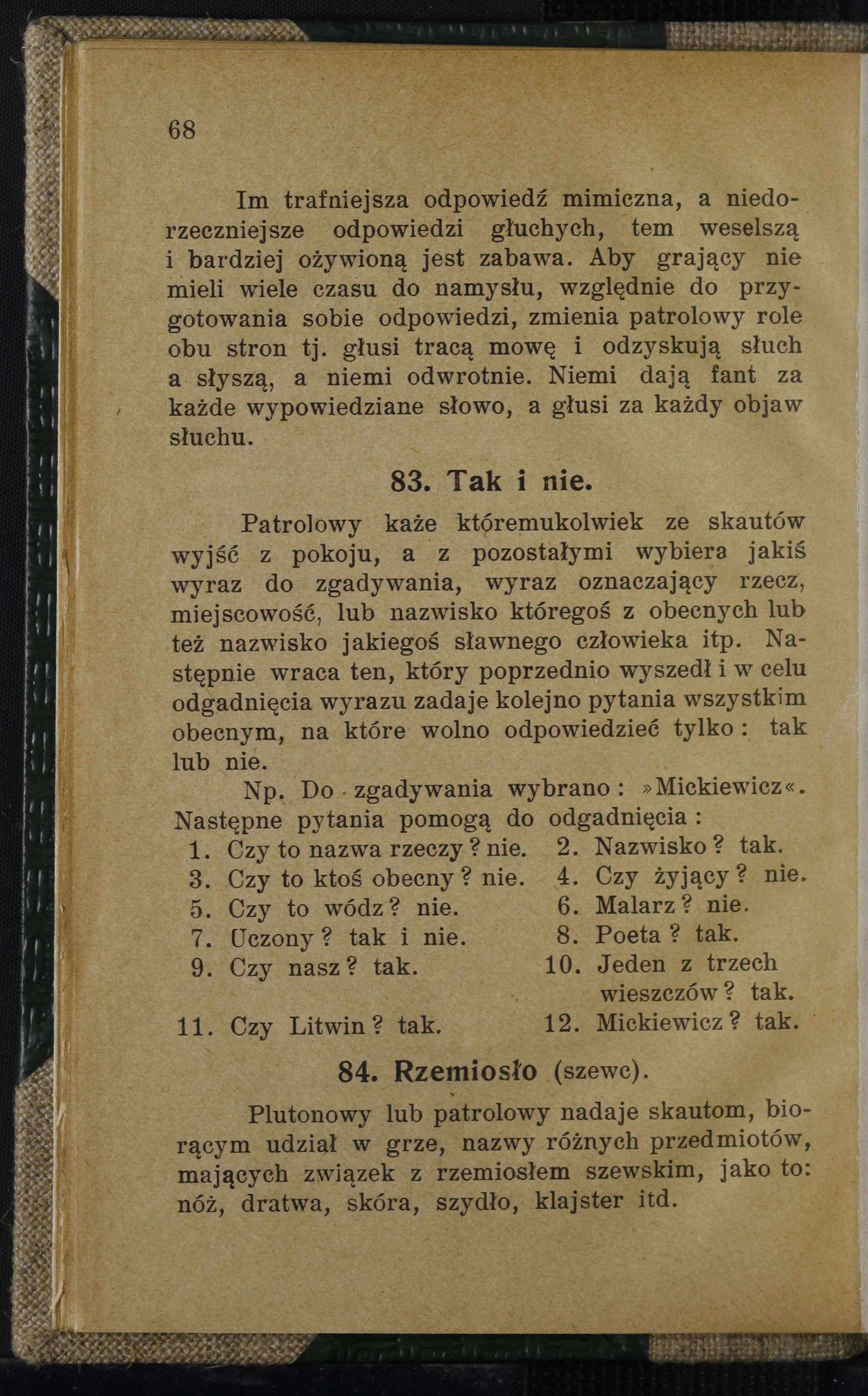
Section titled “Translated text”The troop leader or patrol leader assigns the scouts participating in the game names of various objects related to the shoemaker’s craft, such as: knife, waxed thread, leather, awl, paste, etc.
Next, the patrol leader directing the game sits in the center of a circle formed by the players and starts the game by addressing one of the players, who is called the merchant, and asks: »What do you want, neighbor?« The merchant must respond with a sentence in which the last word must necessarily be one of the previously assigned names. The player called in this way stands up and delivers another sentence, which again ends with the name of their comrade, and so on, until someone says the word »workbench.« Then, everyone rushes out of the room, and the master must manage to say a sentence with any name before the runners cross the room’s threshold. The mentioned player immediately returns to their place and without hesitation names one of their comrades, that one returns and names another, and so on, so that no one crosses the threshold. Everyone sits down again, and the game continues. If, however, one of the players managed to run out of the room, the game is interrupted, the remaining players and the master give forfeits, and the one who ran out becomes the game leader.
Variation of the game: After the word workbench, everyone except the master runs out, but not immediately—they first run around the room (or table). When the master names one of the players, the others no longer have the right to cross the threshold, even if they are already at it, but must return and go around the room (or table) once more. Meanwhile, the called player must say another sentence ending with a comrade’s name, everyone circles the room again, and so on, until everyone returns to their places. The player who managed to run out of the room shouts: »I’m home!« and the game ends with the rest giving forfeits. Here is an example of the game’s course:
Master: What do you want, neighbor?
Merchant: I came to ask if my shoes are ready.
Shoes: Ask Mr. Waxed Thread.
Waxed Thread: The master will answer for me.
Master: I would have made your shoes long ago, but I lack materials.
Materials: You can buy them at the shop.
Shop: You just need to have money.
Money: But the money is in the master’s pocket.
Master: I’m short on funds right now, unless the neighbor lends me some.
Merchant: I won’t lend you any, as I’m dissatisfied with your work; in the last pair of shoes, I completely wore out the soles and heels.
Soles and Heels (together): Ha! Poor quality goods.
Materials: No, it’s the waxed thread that doesn’t hold.
Waxed Thread: It’s the fault of the blunt awl.
Awl: The master bought a blunt awl.
Master: It got blunt when it fell on the workbench.
Everyone: Let’s run (they run).
Master: If only they left the money.
Money (returning): To buy materials.
Materials (returning): What’s the use of materials without waxed thread.
Waxed Thread (returning): What’s the use of waxed thread without…
Shoes (ran out the door): I’m home.
This game can similarly be adapted to all other crafts and professions, so the shoemaker can be replaced by: gardener, locksmith, carpenter, (or even an official or writer), etc.
Of course, the game participants then bear names related to the chosen craft, and the conversation also undergoes appropriate changes. For a good adaptation of this game to other professions or crafts, [merit] marks.
Source scan: Polona / National Library, marked “Public Domain”. View scan — image 80.
Metadata
Section titled “Metadata”- Type: game
- Traits: Not stated in the source
- Source: Herman A. Mojmir, Ćwiczenia i zabawy skautowe (1912)
- Printed pages: 68–71
- Digital edition: Digital edition · Source record
- Open the edition at the relevant page: p. 68
- Read the source text: ciz-084