Scout Chess
Translation details
Model:mistral-large-2512.Translated text
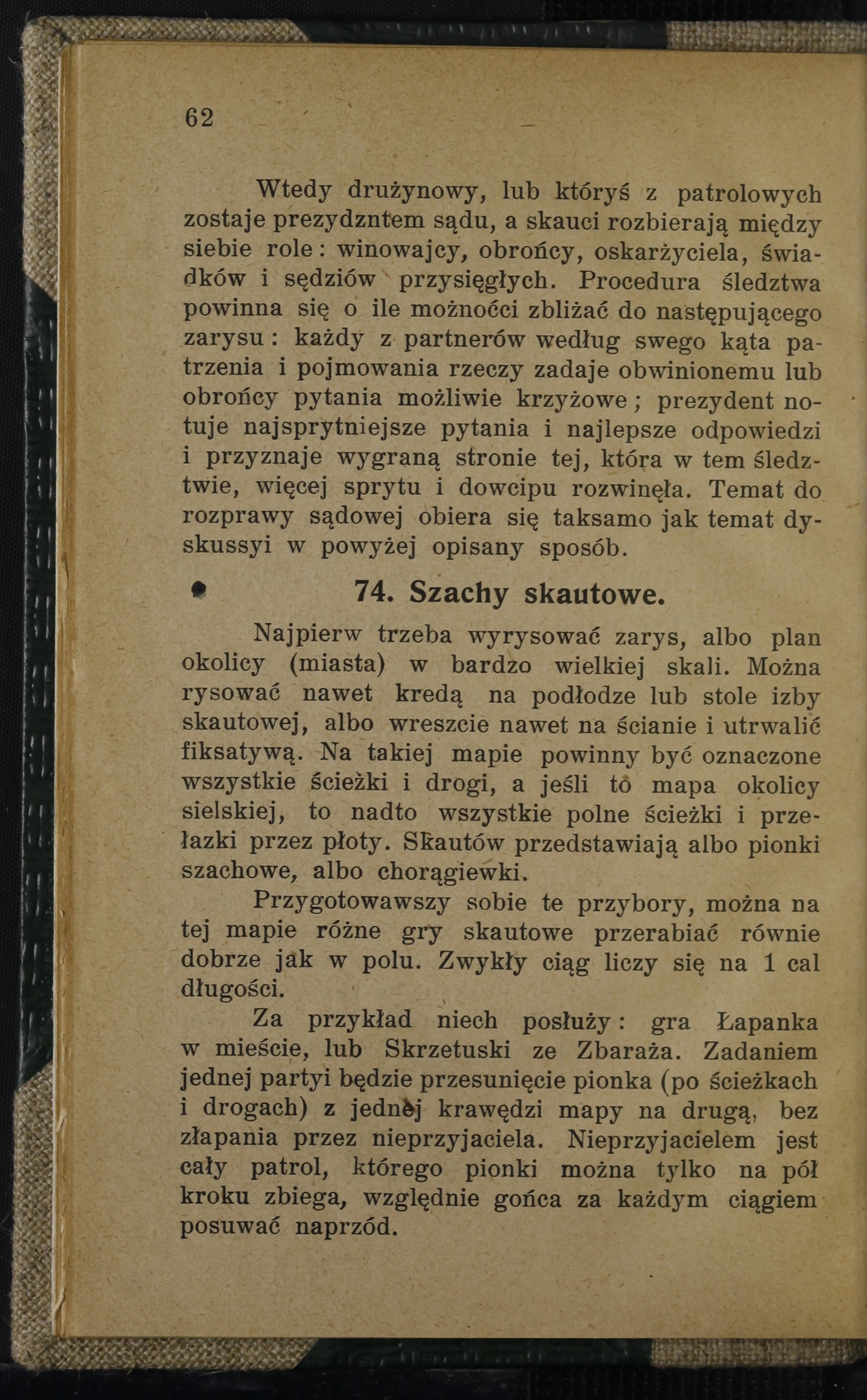
Section titled “Translated text”First, one must draw the outline or plan of the area (town) on a very large scale. It can be drawn even with chalk on the floor or table of the scout room, or even on a wall, and then fixed with fixative. On such a map, all paths and roads should be marked, and if it is a map of a rural area, additionally all field paths and gaps in fences. Scouts are represented either by chess pieces or small flags.
Having prepared these materials, various scout games can be played on this map just as well as in the field. An ordinary move is counted as 1 inches in length.
For example, consider the game Catching in the City or Skrzetuski from Zbarazh. The task of one party will be to move a piece (along paths and roads) from one edge of the map to the other without being caught by the enemy. The enemy is an entire patrol, whose pieces can only be moved half a step forward each turn, or the pursuer can be advanced each move.
To capture the fugitive, 2 scouts from the enemy patrol must cut off the fugitive’s path so that they drive them into a corner or surround them with a greater number of pieces. Obviously, both the fugitive and the capturing enemies are only allowed to move along the marked paths and roads, not cross-country.
Source scan: Polona / National Library, marked “Public Domain”. View scan — image 74.
Metadata
Section titled “Metadata”- Type: game
- Traits: Not stated in the source
- Source: Herman A. Mojmir, Ćwiczenia i zabawy skautowe (1912)
- Printed pages: 62–63
- Digital edition: Digital edition · Source record
- Open the edition at the relevant page: p. 62
- Read the source text: ciz-074