The Tiger Hunt
Translation details
Model:mistral-large-2512.Translated text
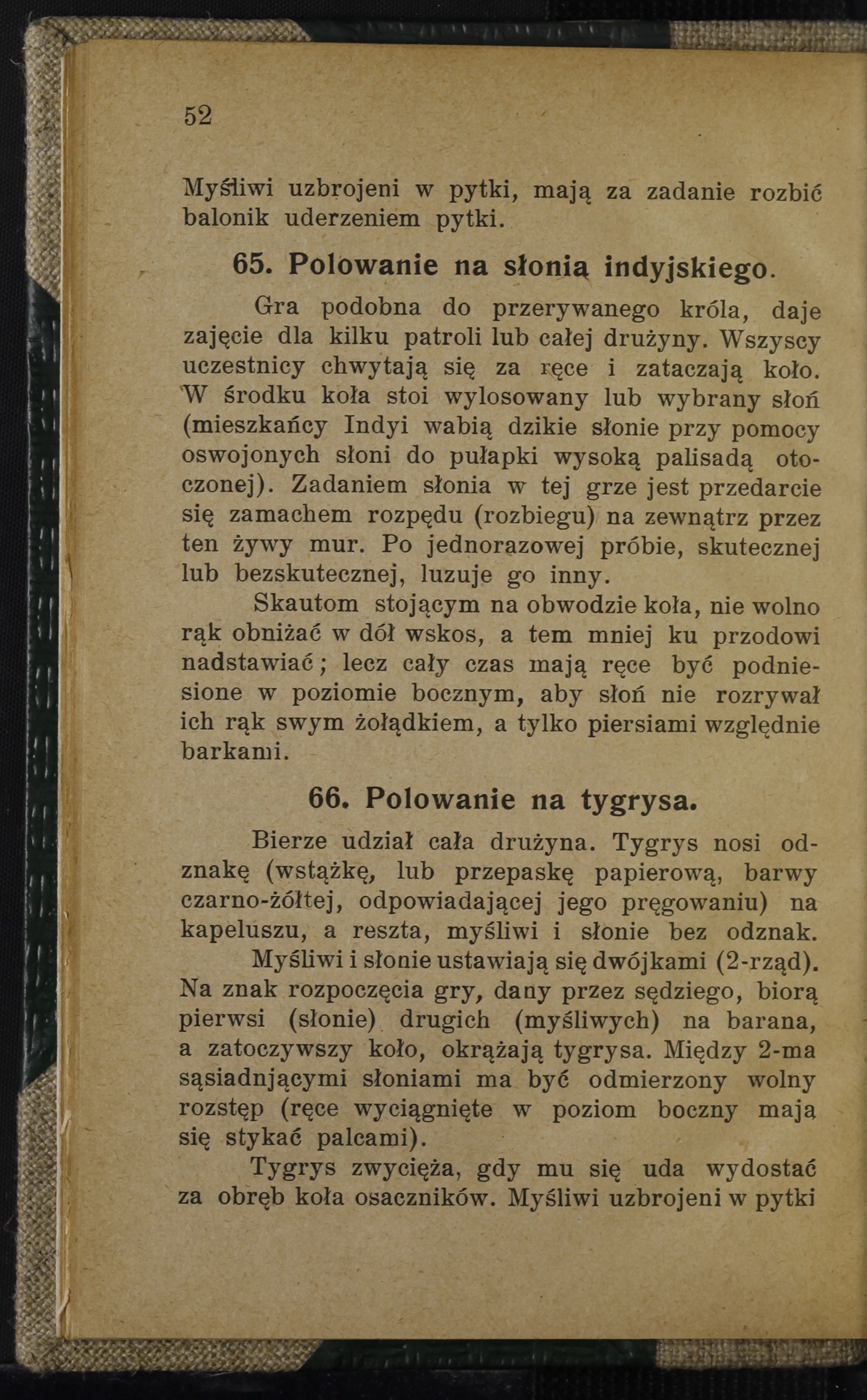
Section titled “Translated text”The entire troop participates. The tiger wears a badge (a ribbon or paper band, black and yellow in color, matching its stripes) on its hat, while the rest—the hunters and elephants—have no badges.
Hunters and elephants line up in pairs (2-row). At the signal to start the game, given by the referee, the first (elephants) carry the second (hunters) on their backs, and after circling once, they encircle the tiger. Between 2 adjacent elephants, a free space must be measured (arms stretched out horizontally should touch fingertips).
The tiger wins if it manages to escape beyond the circle of besiegers. The hunters, armed with sticks, defend their position and prevent the tiger from breaking through. The tiger must use all its cunning, agility, and speed to avoid being struck by a stick and escape the circle. If struck once, it must attempt to break through elsewhere, and after being struck 3 times, it is considered dead, and the hunters claim victory. Killing or escaping the tiger ends one round of the game. In the next round, roles are reversed: the second group carries the first on their backs, and a new tiger attempts to escape.
A variation of this game involves arming the tiger with a stick as well. In this case, every strike from the tiger is lethal, and whether an elephant or a hunter is hit by the tiger’s stick, both are removed from the game along with their partner. The tiger wins if it escapes the circle or eliminates half of the opponents.
Source scan: Polona / National Library, marked “Public Domain”. View scan — image 64.
Metadata
Section titled “Metadata”- Type: game
- Traits: Not stated in the source
- Source: Herman A. Mojmir, Ćwiczenia i zabawy skautowe (1912)
- Printed pages: 52–53
- Digital edition: Digital edition · Source record
- Open the edition at the relevant page: p. 52
- Read the source text: ciz-066