Single-Handed Against the Bear
Translation details
Model:mistral-large-2512.Translated text
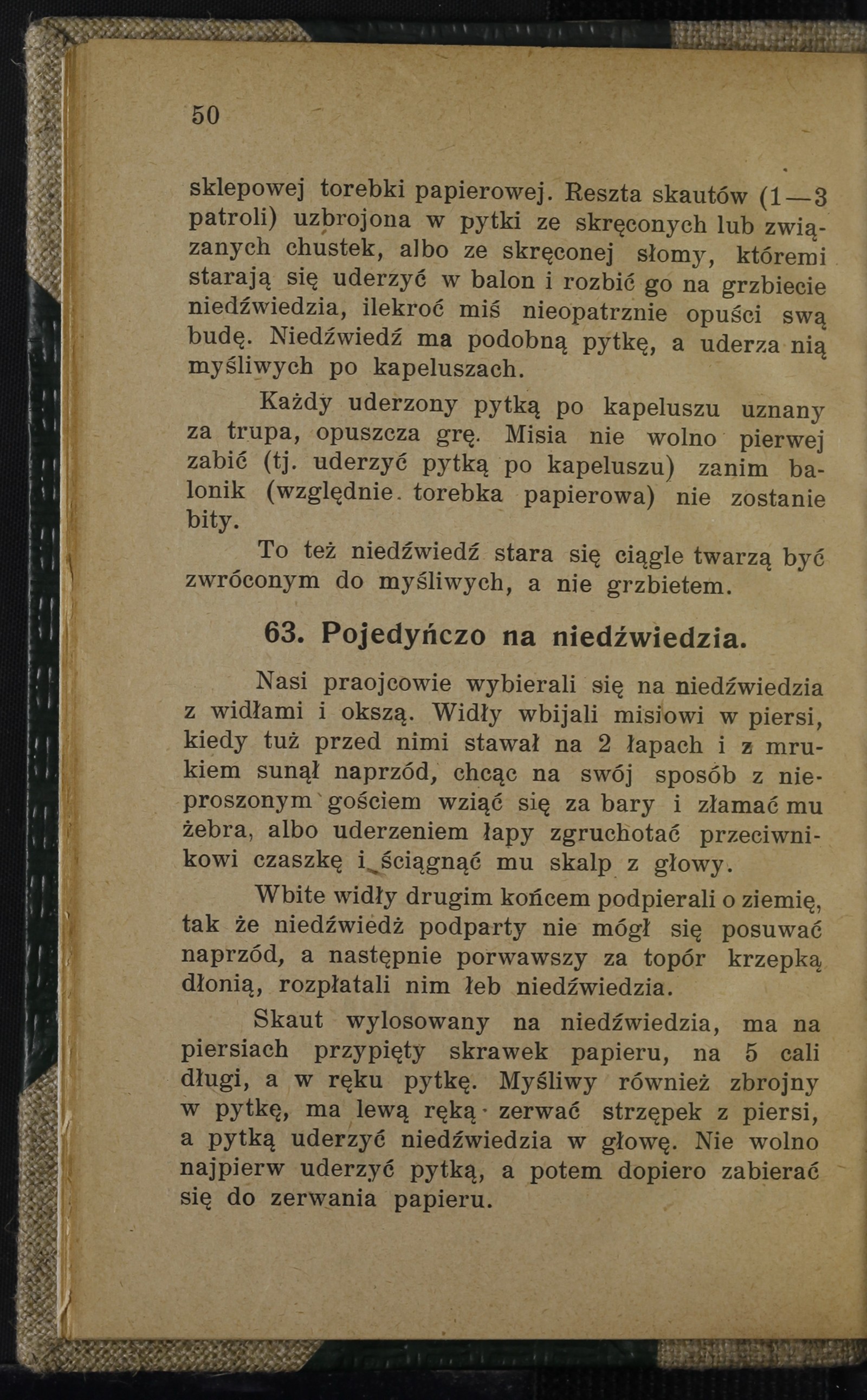
Section titled “Translated text”Our ancestors went after a bear with pitchforks and a poleaxe. They drove the pitchfork into the bear’s chest when it reared up on its 2 legs right in front of them, growling and advancing, ready to grapple with the uninvited guest in its own way—crushing his ribs or shattering the opponent’s skull with a paw strike and scalping him.
They braced the other end of the embedded pitchfork against the ground, so the bear, thus propped, could not move forward. Then, gripping the axe firmly, they split the bear’s head open with it.
The scout chosen to play the bear wears a strip of paper pinned to his chest, 5 inches long, and holds a club in his hand. The hunter, also armed with a club, must use his left hand to tear the strip from the bear’s chest and strike the bear’s head with the club. He may not strike first with the club and then attempt to tear the paper.
The bear may not shield the paper with his hand; his right hand (holding the club) must be raised, and his left hand placed behind his back. The bear defends himself by aiming his club at the hunter’s head (the Native Americans likely learned scalping from bears), and a hunter hit on the head with the club is out of the game, considered killed. If struck 3 times on the arm or back (no other blows are allowed), he is out as severely wounded. The next scout in the patrol takes the place of the departing hunter. Simply tearing the paper without striking the bear’s head with the club does not end the game; the bear receives a new strip of paper and play continues. The game involves 2—8 scouts, with one bear for every 4 hunters (taking turns).
Source scan: Polona / National Library of Poland, marked “Public Domain”. View scan — page 62.
Metadata
Section titled “Metadata”- Type: game
- Traits: Not stated in the source
- Source: Herman A. Mojmir, Ćwiczenia i zabawy skautowe (1912)
- Printed pages: 50–51
- Digital edition: Digital edition · Source record
- Open the edition at the relevant page: p. 50
- Read the source text: ciz-063