Night Watches
Translation details
Model:mistral-large-2512.Translated text
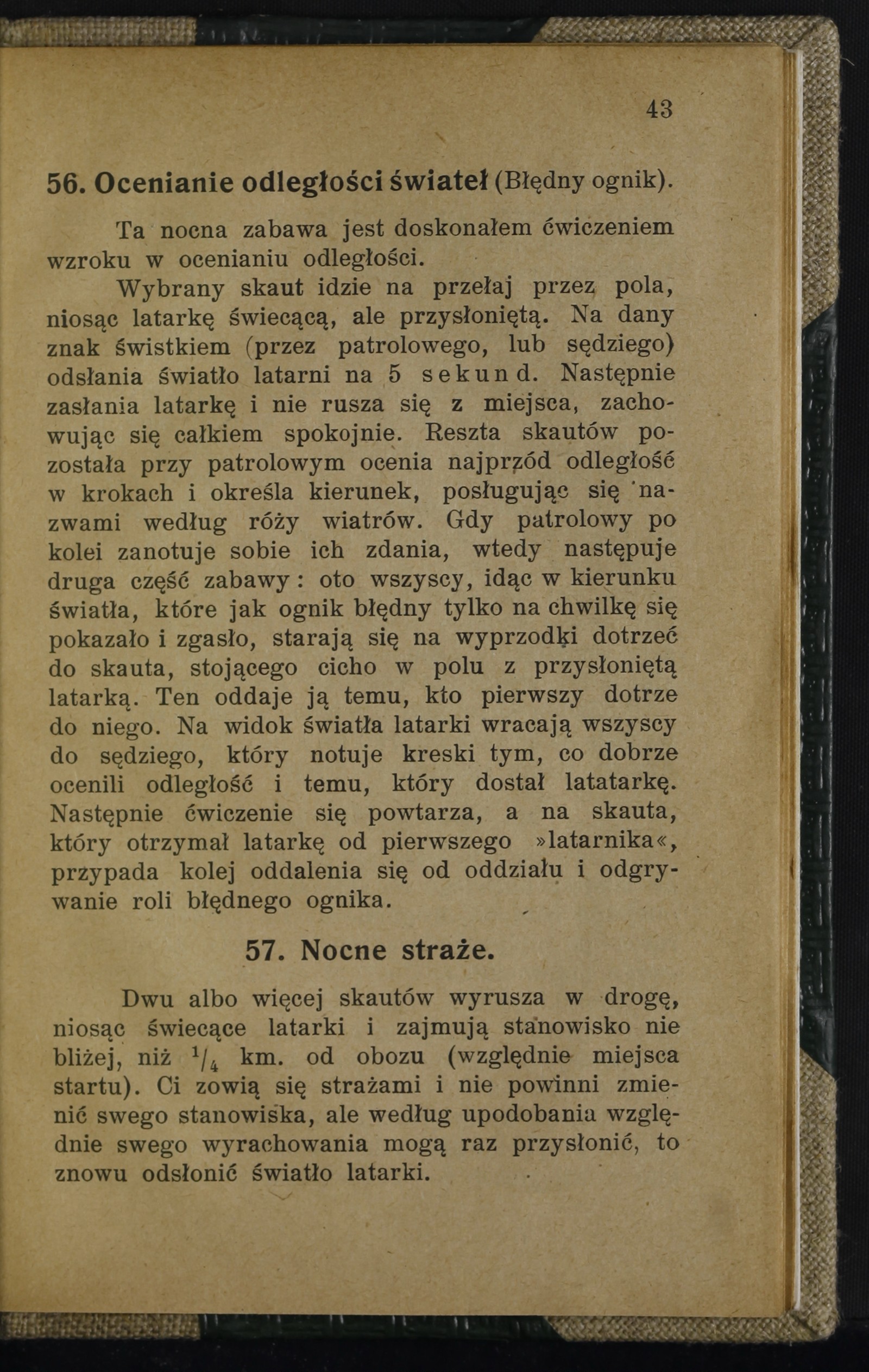
Section titled “Translated text”Two or more scouts set out on the road, carrying lit lanterns, and take up a position no closer than one-quarter of a kilometer from the camp (or the starting point, respectively). These are called the watches and should not change their position, but may, according to preference or calculation, now cover and then uncover the light of their lantern.
After 10 minutes, a scout with a strongly shining lantern (e.g., an acetylene lamp with a reflector) sets out to find the watches. This scout is called the runner and should not cover the light of their lantern at any time during the game.
After 2 minutes, the remaining scouts set out to catch the runner and the watches.
The watches uncover their lanterns when they think the runner is near, generally to make it easier for them to find their positions; they cover the lantern lights from the pursuit, however, so as not to betray their position.
When the runner discovers a watch, the latter extinguishes their lantern and returns to camp, and when the runner has found all the watches, they too return, and the victory in this case belongs to the runner and the watches. Conversely, if the pursuit catches the runner and the watches, the pursuers win. If only the runner is caught, or a few watches, the points are divided.
No scout should be within a radius of 100 paces from the starting point (camp, scout house, etc.) during this game.
Source of scan: Polona / National Library, marked “Public Domain”. View scan — page 55.
Metadata
Section titled “Metadata”- Type: game
- Traits: Not stated in the source
- Source: Herman A. Mojmir, Ćwiczenia i zabawy skautowe (1912)
- Printed pages: 43–44
- Digital edition: Digital edition · Source record
- Open the edition at the relevant page: p. 43
- Read the source text: ciz-057