Worob's Testament
Translation details
Model:mistral-large-2512.Translated text
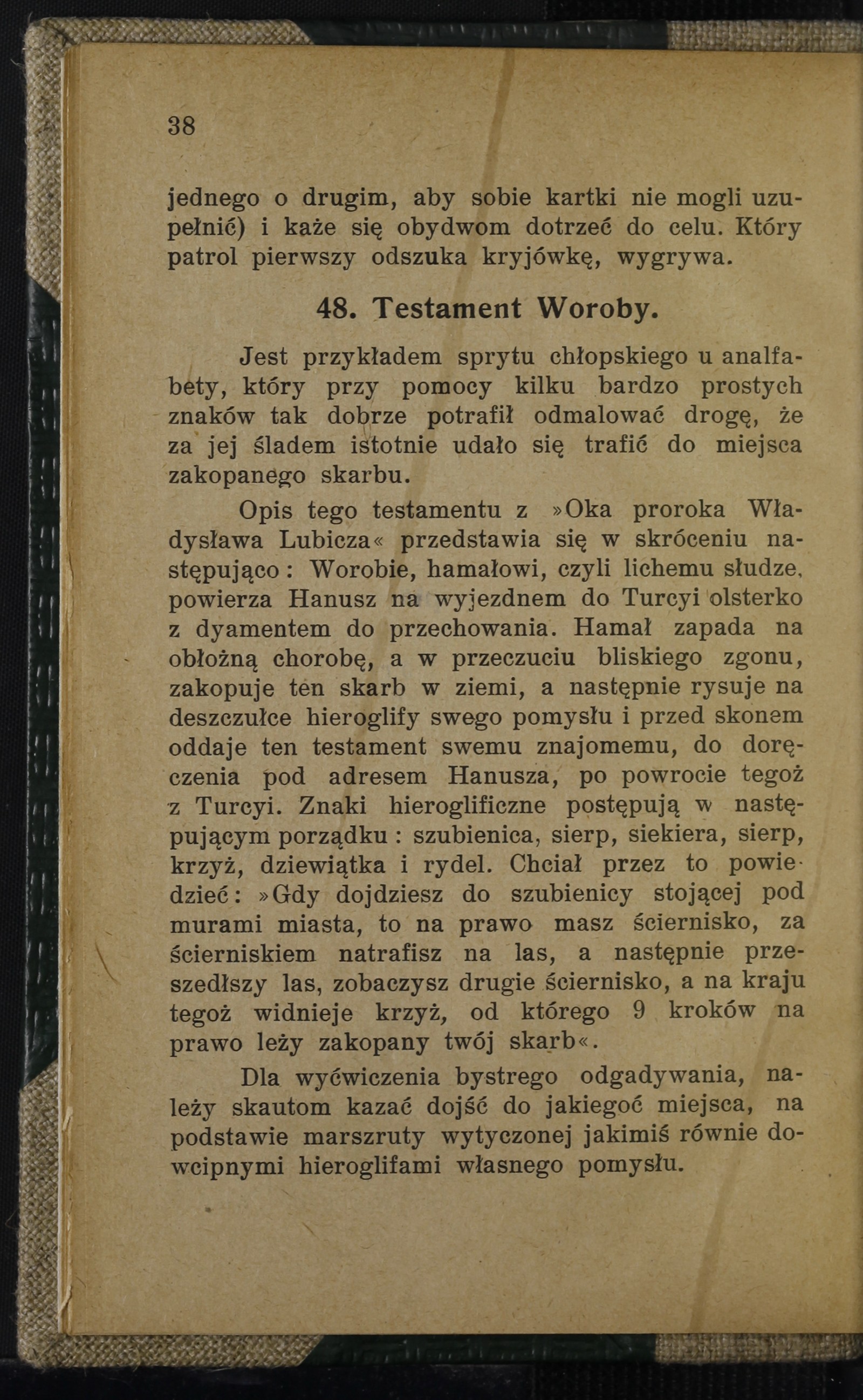
Section titled “Translated text”It is an example of peasant cunning in an illiterate man who, using just a few very simple symbols, was able to map out a route so well that it indeed led to the spot where a treasure was buried.
The account of this testament from The Prophet’s Eye by Władysław Lubicz is summarized as follows: Worobie, a hamał (a lowly servant), is entrusted by Hanusz, upon the latter’s departure for Turkey, with a pouch containing a diamond for safekeeping. The hamał falls gravely ill and, sensing his impending death, buries the treasure in the ground. He then sketches hieroglyphs of his own invention on a wooden plank and, before his passing, hands this testament to an acquaintance to deliver to Hanusz upon his return from Turkey. The hieroglyphic signs appear in the following order: a gallows, a sickle, an axe, a sickle, a cross, the number nine, and a spade. Through these, he meant to say: “When you reach the gallows standing by the city walls, to the right you will find a stubble field; beyond the stubble field, you will come upon a forest; after passing through the forest, you will see another stubble field, and at its edge stands a cross. From there, 9 paces to the right lies your buried treasure.”
To train sharp deduction, scouts should be tasked with finding a location based on a route marked by similarly clever hieroglyphs of their own design.
Source scan: Polona / National Library, marked “Public Domain.” View scan — image 50.
Metadata
Section titled “Metadata”- Type: game
- Traits: Not stated in the source
- Source: Herman A. Mojmir, Ćwiczenia i zabawy skautowe (1912)
- Printed pages: 38–39
- Digital edition: Digital edition · Source record
- Open the edition at the relevant page: p. 38
- Read the source text: ciz-048