Fox Hunt for the Cat
Translation details
Model:mistral-large-2512.Translated text
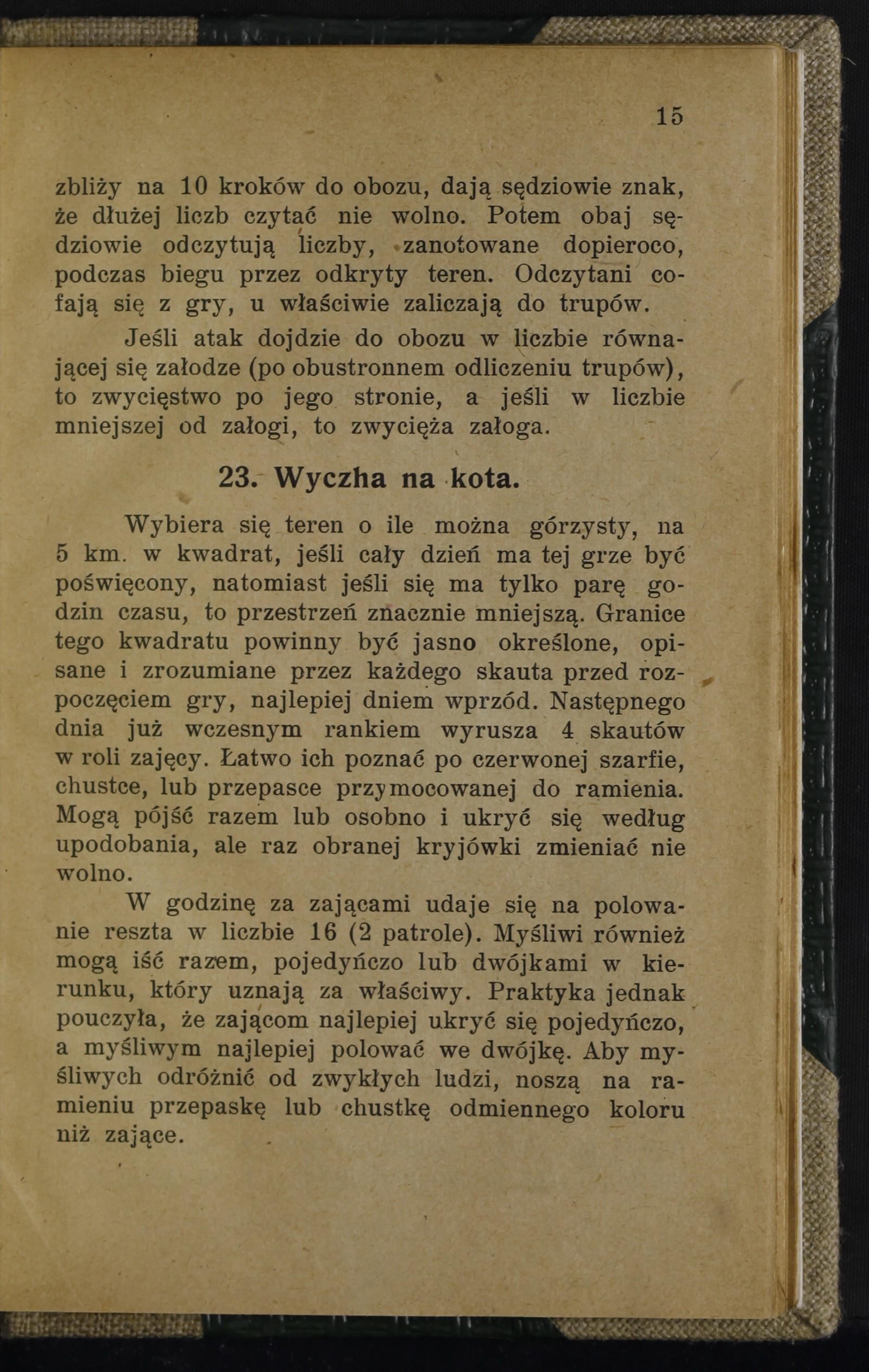
Section titled “Translated text”A terrain is chosen, preferably hilly, covering an area of 5 kilometres square if the entire day is to be devoted to this game. If only a few hours are available, the space should be significantly smaller. The boundaries of this square must be clearly defined, described, and understood by every Scout before the game begins, preferably a day in advance. The following day, early in the morning, 4 Scouts set out in the role of hares. They are easily recognised by a red sash, neckerchief, or armband fastened to their arm. They may go together or separately and hide as they please, but once a hiding place is chosen, it may not be changed.
An hour after the hares, the rest, numbering 16 (2 patrols), set out on the hunt. The hunters may also proceed together, singly, or in pairs in whatever direction they deem appropriate. Experience has shown, however, that hares are best hidden singly, while hunters are most effective when working in pairs. To distinguish hunters from ordinary people, they wear an armband or neckerchief of a different colour from that of the hares.
The game consists in the hunters tracking the hare by its traces (tracking irons, coloured paper, confetti, peas, corn, etc.), and once tracked, catching up to and capturing it. A hare is considered caught when a hunter touches it with their hand. This is a very lively and varied game, which trains both sides in hiding, stalking, tracking, and getting to know the area. A set evening hour, announced to all, ends the game, and the judges award points to the winners based on whether a hare was caught or the greatest number of discarded traces (confetti, peas, etc.) was collected.
Source scan: Polona / National Library, marked “Public Domain”. View scan — image 27.
Metadata
Section titled “Metadata”- Type: game
- Traits: Not stated in the source
- Source: Herman A. Mojmir, Ćwiczenia i zabawy skautowe (1912)
- Printed pages: 15–16
- Digital edition: Digital edition · Source record
- Open the edition at the relevant page: p. 15
- Read the source text: ciz-023