Capture of the Flags
Translation details
Model:mistral-large-2512.Translated text
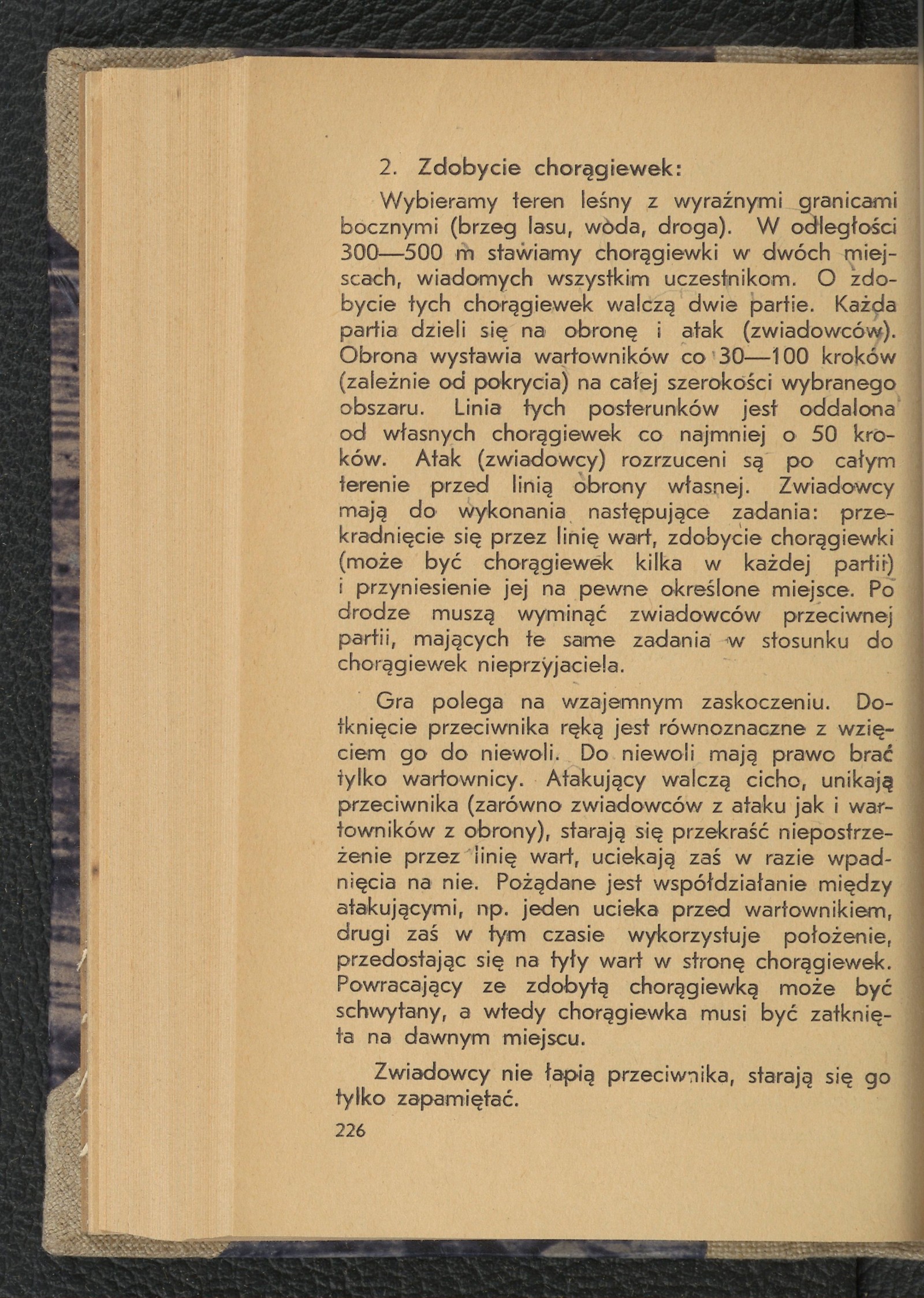
Section titled “Translated text”We choose a forested area with clear side boundaries (forest edge, water, road). At a distance of 300—500 paces, flags are placed in two locations known to all participants. Two teams compete to capture these flags. Each team divides into defense and attack (scouts). The defense positions sentries every 30—100 paces (depending on cover) across the entire width of the chosen area. The line of these posts is at least 50 paces away from their own flags. The attack (scouts) is scattered across the entire terrain in front of their own defense line. Scouts have the following tasks: sneaking through the sentry line, capturing the flag (there may be several flags in each team), and bringing it to a specific designated place. Along the way, they must evade scouts from the opposing team, who have the same tasks regarding the enemy’s flags.
The game relies on mutual surprise. Touching an opponent with a hand is equivalent to taking them prisoner. Only sentries have the right to take prisoners. Attackers fight quietly, avoid opponents (both scouts from the attack and sentries from the defense), try to sneak unnoticed through the sentry line, and flee if detected. Cooperation among attackers is desirable, for example, one distracts a sentry by fleeing, while another takes advantage of the situation to slip behind the sentry toward the flags. A scout returning with a captured flag can be caught, in which case the flag must be returned to its original place.
Scouts do not capture opponents; they only try to remember them.
A scout or a member of the defense spotted by an opposing scout receives a negative point.
Source scan: Polona / National Library, marked “Public Domain”. View scan — page 234.
Metadata
Section titled “Metadata”- Type: game
- Traits: Not stated in the source
- Source: Jan Jasiński, Gry i ćwiczenia terenowe (Harce terenowe) (1938)
- Printed pages: 226–227
- Digital edition: Digital edition · Source record
- Open the edition at the relevant page: p. 226
- Read the source text: gct-187