Who Faster?
Translation details
Model:mistral-large-2512.Translated text
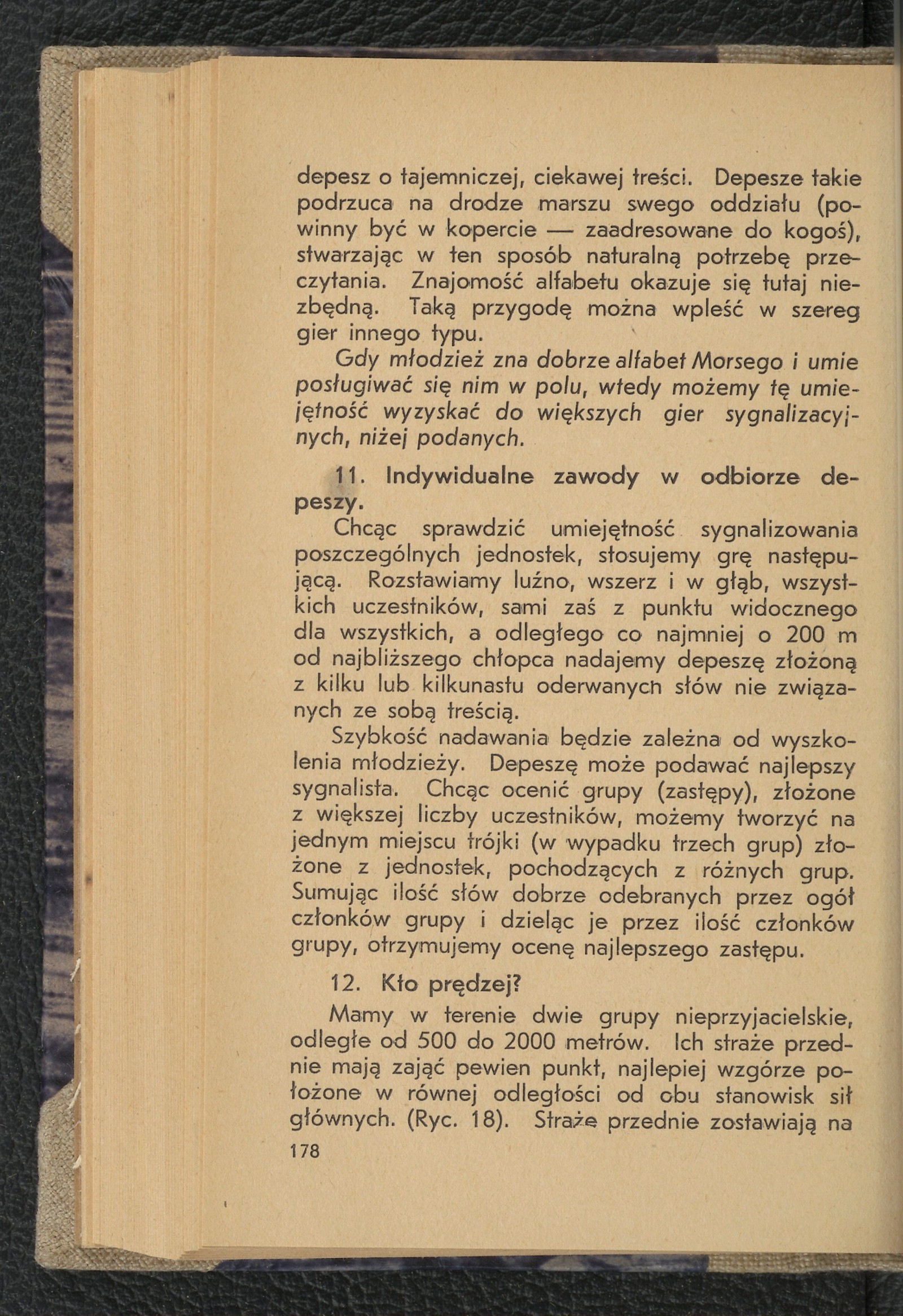
Section titled “Translated text”There are two enemy groups in the field, separated by a distance of 500 to 2000 meters. Their advance guards are to occupy a certain point, preferably a hill located equidistant from both main force positions. (Fig. 18). Along their march route, the advance guards leave behind one signaling station (x 2) in communication with the station (x 1) at the main unit.
Fig. 18.
The advance guards reach the hill, where a skirmish ensues. Simultaneously, they dispatch messengers to their signaling stations (x 2) with a written message of the following content: “The enemy, in the strength of one company, is marching on hill 99. Assistance as quickly as possible is necessary.” This dispatch is then relayed to the main force using flags or signaling boards. The victorious group is the one whose main forces, thanks to the received dispatch, occupy hill 99 more quickly.
Note: The game’s premise should not be known to the boys; only the order for the main forces to halt at the designated locations should be issued, simultaneously instructing the advance guard to reach the marked hill and leave a signaling station en route at a location where communication with the main force is possible.
Several intermediate stations may be established between the hill and the main force position.
Signaling Station. During training, it should consist of two individuals: a scribe and a signaler. Later, a third person—the commander—is added. The station’s operations will be based on selecting an appropriate background for the signaling boards and occupying a position where the neighboring station is clearly visible. However, in special cases, it must be remembered that the station should not be spotted by the enemy.
The signaler receives individual signs and dictates them to the scribe: initially as separate marks (dot, dash, etc.), later as letters. The scribe repeats the given sign (letter) and records it. When transmitting, the scribe dictates the sign (letter) from the written dispatch, while the signaler repeats and signals it. These roles should be frequently rotated.
Source scan: Polona / National Library, marked “Public Domain.” View scan — image 186.
Metadata
Section titled “Metadata”- Type: game
- Traits: Not stated in the source
- Source: Jan Jasiński, Gry i ćwiczenia terenowe (Harce terenowe) (1938)
- Printed pages: 178–180
- Digital edition: Digital edition · Source record
- Open the edition at the relevant page: p. 178
- Read the source text: gct-109