The Treasure of the Iroquois
Translation details
Model:mistral-large-2512.Translated text
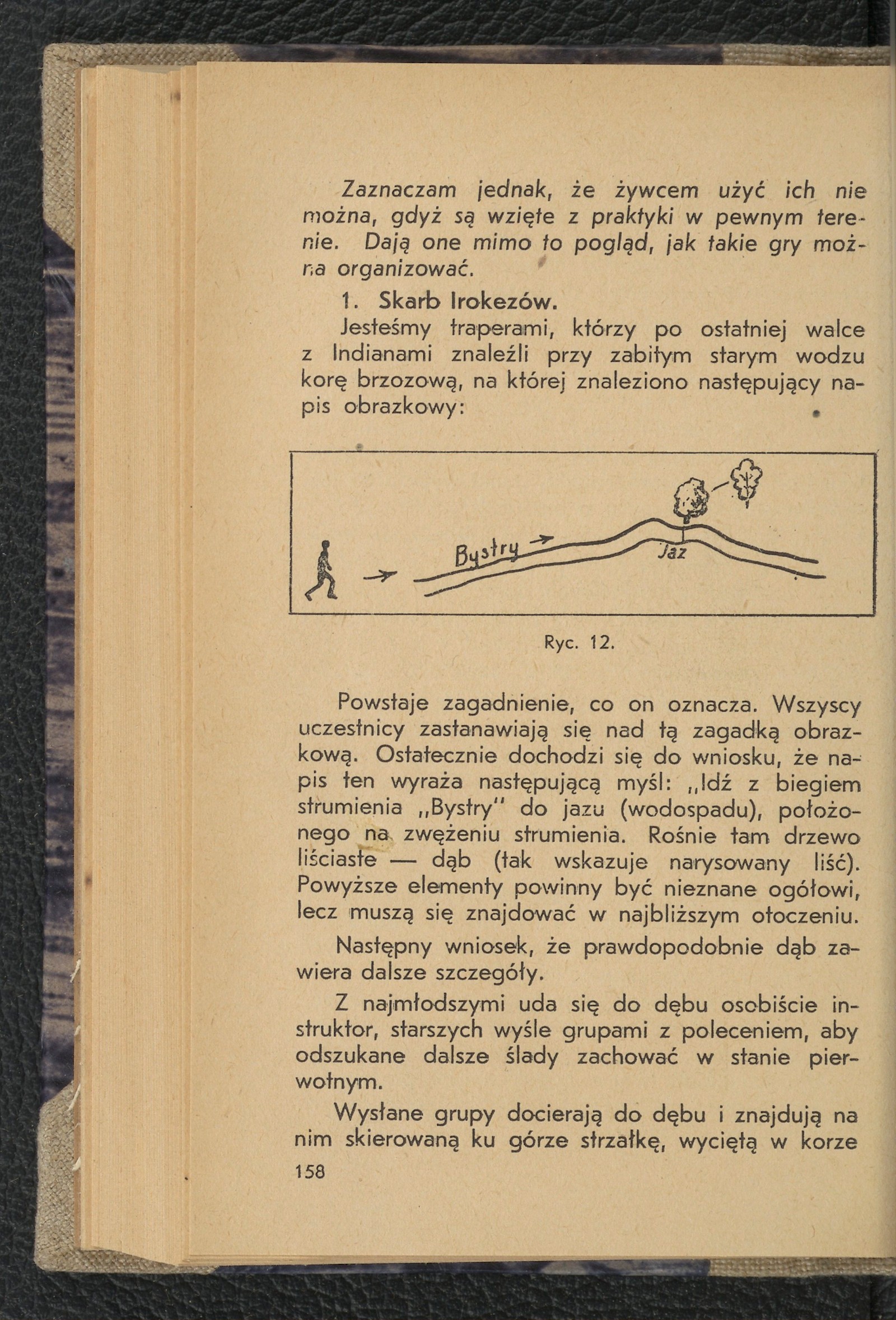
Section titled “Translated text”We are trappers who, after the last battle with the Indians, found birch bark on the slain old chieftain, bearing the following pictographic inscription:
Fig. 12.
The question arises as to what it means. All participants ponder this pictorial riddle. Eventually, it is concluded that the inscription conveys the following thought: “Follow the current of the stream ‘Swift’ to the weir (waterfall) located at the narrowing of the stream. There grows a broadleaf tree—an oak (as indicated by the drawn leaf). The aforementioned elements should be unknown to the general public but must be found in the immediate surroundings.
The next conclusion is that the oak likely contains further details.
The instructor personally takes the youngest to the oak, while the older boys are sent in groups with the instruction to preserve any further traces found in their original state.
The dispatched groups reach the oak and find an upward-pointing arrow carved into the tree bark, and in a small hollow on one of the large branches—a roll of birch bark with the following drawing:
Fig. 13.
We read it as: “Look to the east (it should be assumed from the place where the bark was found), and you will see a hill, forested on one side.” The cross above the summit indicates that further information must be sought there.
Indeed, at the summit, we find a cross made of stones partially buried in the ground. What does it mean? Consider it. Everyone will conclude that this is where we must search.
It is likely that one of the participants will suggest lifting the central stone (let it be the larger one). If no such proposal is made, it should be suggested. We carefully lift the stone, beneath which we find a tin can (a box from paste, canned goods, etc.), and inside it, another piece of birch bark with a drawing:
Fig. 14.
The sight of this drawing suggests that somewhere in the terrain, there are three spruces of different sizes standing together. We find them and head toward the largest one, as indicated by the cross on the drawing. At the largest spruce, we find a stump with an Indian sign: 20 →, meaning: “search for a message 20 paces in the given direction.” We find the message (also on birch bark) in another stump. This message again contains a drawing:
Fig. 15.
We read: “Dig to the west of the stump, and you will find lumps of gold.” (Place some object in this spot.)
Depending on the available time, we may create more or fewer such intermediate stations, and according to the age and skill of the boys, we can make the pictorial rebuses more difficult.
Source of scan: Polona / National Library, marked “Public Domain.” View scan — image 166.
Metadata
Section titled “Metadata”- Type: game
- Traits: Not stated in the source
- Source: Jan Jasiński, Gry i ćwiczenia terenowe (Harce terenowe) (1938)
- Printed pages: 158–160
- Digital edition: Digital edition · Source record
- Open the edition at the relevant page: p. 158
- Read the source text: gct-090