History in the Snow
Translation details
Model:mistral-large-2512.Translated text
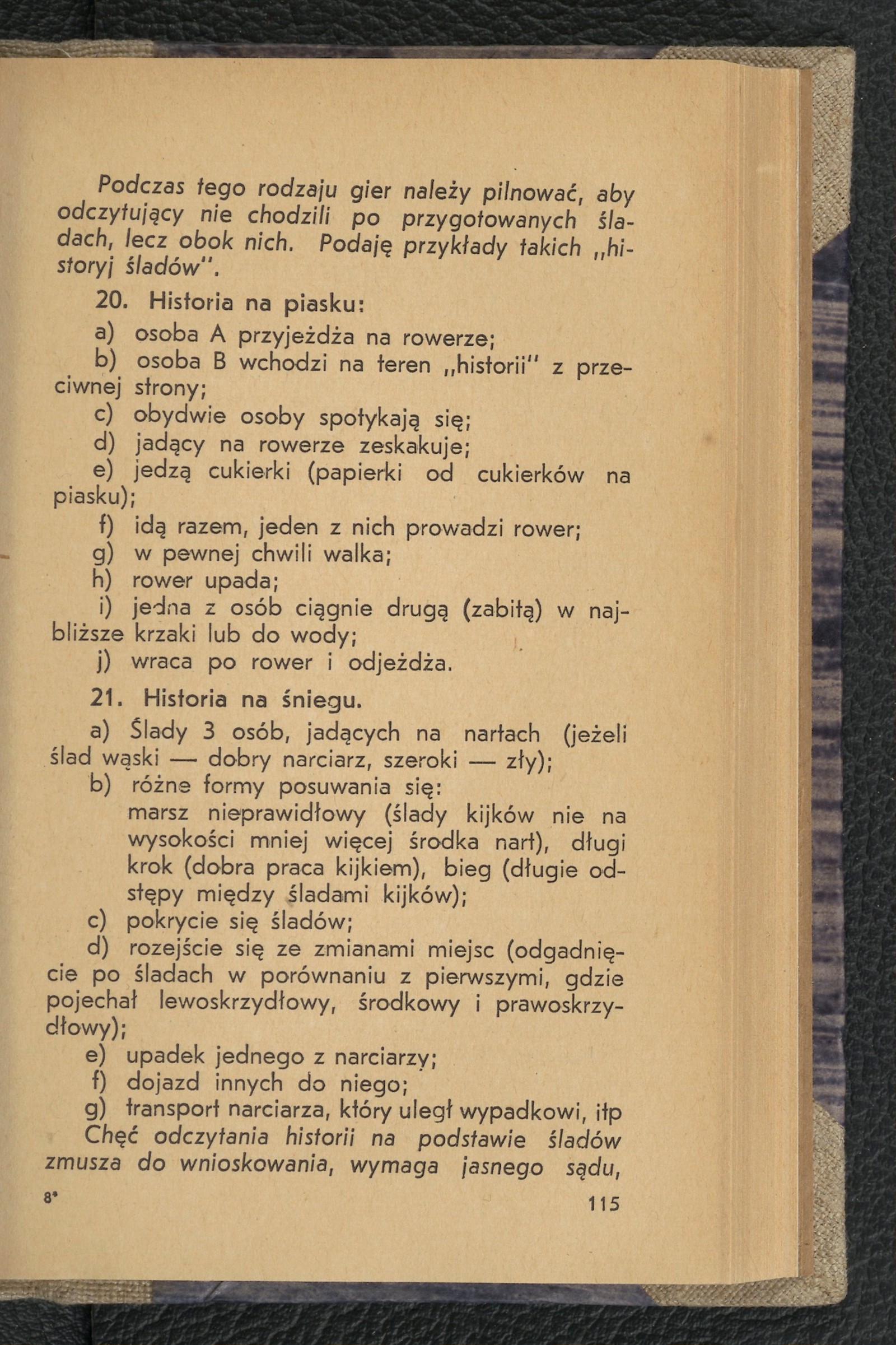
Section titled “Translated text”a) Tracks of 3 people skiing (if the track is narrow — a good skier, wide — a poor one); b) various forms of movement: incorrect stride (pole marks not roughly at the midpoint of the skis), long step (good use of the pole), running (long distances between pole marks); c) overlapping tracks; d) divergence with position changes (determining from the tracks, in comparison with the first ones, where the left-flank, center, and right-flank skiers went); e) the fall of one of the skiers; f) others arriving to assist him; g) transporting the skier who suffered an accident, etc. The desire to read history based on tracks compels reasoning, requires clear judgment, and a certain sharpness of thought. A well-prepared exercise is an interesting challenge. The patrol that reads the history with the greatest probability wins. Points are awarded separately for each action marked in the snow.
This type of tracking requires the instructor to have a little initiative and creativity, as well as time to prepare the route. To prepare it calmly, the practicing groups should be sent into a more distant area beforehand with the task of conducting another game.
Source of scan: Polona / National Library, marked “Public Domain”. View scan — image 123.
Metadata
Section titled “Metadata”- Type: game
- Traits: Not stated in the source
- Source: Jan Jasiński, Gry i ćwiczenia terenowe (Harce terenowe) (1938)
- Printed pages: 115–116
- Digital edition: Digital edition · Source record
- Open the edition at the relevant page: p. 115
- Read the source text: gct-050