Near and Far
Translation details
Model:mistral-large-2512.Translated text
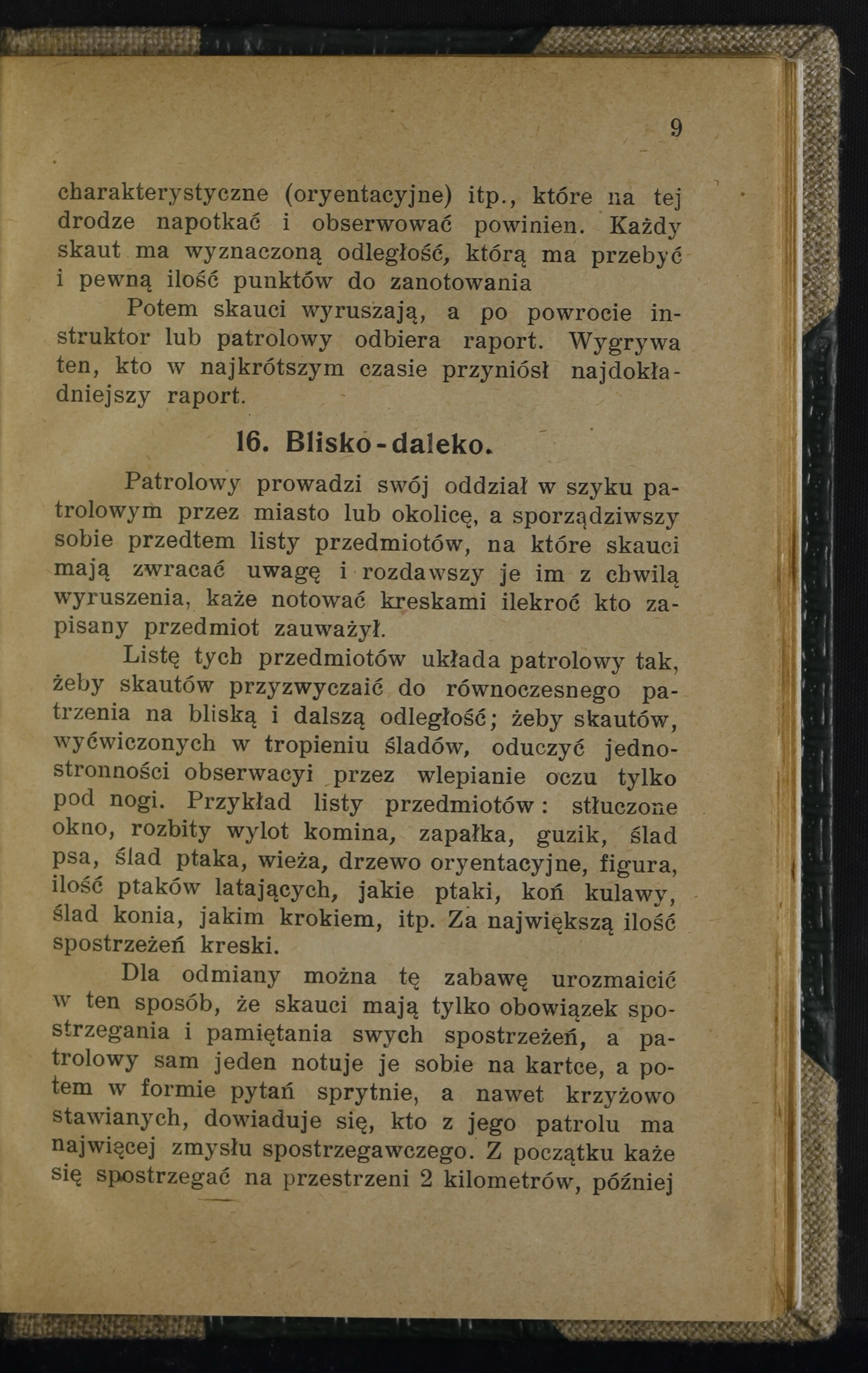
Section titled “Translated text”The patrol leader guides their unit in patrol formation through the town or surrounding area. Having prepared beforehand lists of objects for the Scouts to observe, they distribute these lists at the moment of departure and instruct the Scouts to mark with strokes each time someone spots an item on their list.
The patrol leader compiles the list of objects to train the Scouts in observing both near and distant distances simultaneously, and to break the habit of Scouts—trained in tracking—of focusing solely on the ground beneath their feet. Example list of objects: a broken window, a damaged chimney top, a matchstick, a button, a dog’s track, a bird’s track, a tower, an orientation tree, a statue, the number of birds flying, what kinds of birds, a lame horse, a horse’s track, the horse’s gait, etc. The most observations marked with strokes wins.
For variety, this game can be modified so that the Scouts are only required to observe and remember their observations, while the patrol leader alone notes them down. Later, through clever and even cross-questioning, the patrol leader determines which Scout in the patrol has the keenest observational sense. Initially, observations are made over a distance of 2 kilometers, later gradually extending to longer multi-mile excursions. Example questions: What sound reached your ears as we left the town? From which direction was the wind blowing? How was the smoke rising? How many carriages were coming toward us, and how many were behind us? What was the inscription on the statue? How many geese were swimming? How many roosters were crowing? From which direction were the crows flying? etc.
Source scan: Polona / National Library, marked “Public Domain”. View scan — image 21.
Metadata
Section titled “Metadata”- Type: game
- Traits: Not stated in the source
- Source: Herman A. Mojmir, Ćwiczenia i zabawy skautowe (1912)
- Printed pages: 9–10
- Digital edition: Digital edition · Source record
- Open the edition at the relevant page: p. 9
- Read the source text: ciz-016